The Samoyed is, quite simply, one of the most breathtaking dog breeds on Earth. With their brilliant white cloud-like coat, perpetually smiling expression (the “Samoyed smile” is caused by the upturned corners of their mouth), and joyful, sociable nature, they photograph like a dream and charm everyone they meet. It is no surprise that Samoyed searches in India have exploded through 2024 and into 2025-2026.
But the Samoyed is also one of the most high-maintenance breeds you can own in India — and this guide will be completely honest with you about that. From the significant price, to the extraordinary grooming demands, to the very real climate challenge of keeping a thick-coated Arctic breed comfortable in India’s heat, this is a breed that demands serious commitment and careful preparation. If you can provide it, the Samoyed will reward you with a lifetime of pure, joyful, fluffy devotion.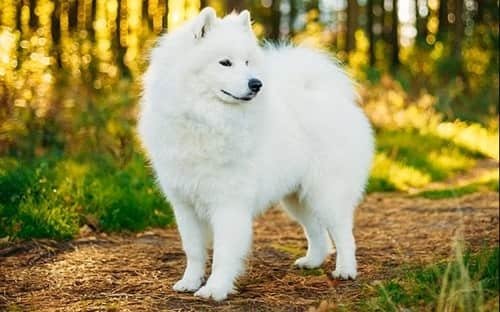
Samoyed Dog Quick Overview
| Attribute | Details |
| Breed Name | Samoyed |
| Origin | Siberia, Russia (bred by the Samoyedic peoples) |
| Size | Medium-Large: 16–30 kg, 46–60 cm |
| Lifespan | 12–14 years |
| Temperament | Friendly, gentle, playful, intelligent, social, vocal, independent |
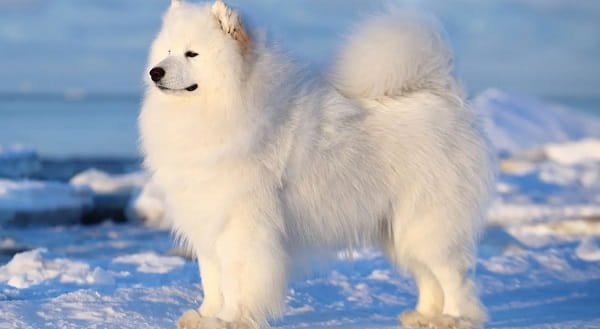
| Coat | Thick double coat — pure white (or biscuit); extremely heavy shedding |
| Price Range (2026) | Rs. 50,000 – Rs. 1,50,000+ |
| KCI / Show / Import Quality | Rs. 80,000 – Rs. 1,50,000+ |
| Monthly Maintenance | Rs. 10,000 – Rs. 25,000 (one of the highest among popular breeds in India) |
| Best For | Active owners with large spaces; hill station residents; experienced owners |
| Climate Suitability | VERY POOR in Indian plains — requires heavy AC; best in hill stations |
About the Samoyed
The Samoyed takes its name from the Samoyedic peoples of Siberia, who bred these dogs for thousands of years as multi-purpose working animals: herding reindeer, pulling sleds, and sleeping alongside their human companions to provide body warmth in -50°C Siberian winters. This close co-evolution with humans explains the Samoyed’s extraordinarily sociable, people-oriented nature — they genuinely need human company to be happy.
The breed came to Western attention in the late 19th century when explorers used Samoyeds on polar expeditions, including several of the early Antarctic voyages. The first Samoyeds arrived in England in 1889 and were subsequently bred to the refined conformation standard we recognise today. In India, significant Samoyed interest emerged from around 2019-2020 and has grown substantially through 2024-2025, driven almost entirely by social media.
Samoyed Price in India 2026 — City-Wise Breakdown
Samoyeds are among the most expensive and rarest breeds in India. Very few established breeders exist and most quality dogs are imported. Prices below reflect the current Indian market as of early 2026.
| City / Category | Min Price (INR) | Max Price (INR) |
| Delhi / NCR | Rs. 60,000 | Rs. 1,20,000 |
| Mumbai | Rs. 65,000 | Rs. 1,30,000 |
| Bangalore | Rs. 55,000 | Rs. 1,10,000 |
| Hyderabad | Rs. 55,000 | Rs. 1,10,000 |
| Chandigarh / North India | Rs. 50,000 | Rs. 1,00,000 |
| Hill Stations (Shimla, Manali, Mussoorie) | Rs. 45,000 | Rs. 90,000 |
| Kolkata | Rs. 50,000 | Rs. 1,00,000 |
| Tier-2 Cities | Rs. 40,000 | Rs. 85,000 |
| Imported (Russia / Europe / US) | Rs. 90,000 | Rs. 1,50,000+ |
| KCI Registered / Show Quality | Rs. 80,000 | Rs. 1,50,000+ |
Pure white is most common and popular; biscuit (cream-tipped) is also a valid breed colour. Black-and-white or colour patterns are not accepted in the Samoyed breed standard. “Teddy bear Samoyed” is a marketing term — not a separate variety. Always verify purity as some sellers in India misrepresent similar-looking mixed breeds as Samoyeds.
Temperament & Suitability
The Samoyed’s personality is as distinctive as its appearance. They are deeply social, joyful, and genuinely love people — all people, not just their family. This makes them terrible guard dogs (they would greet a burglar with the same enthusiastic friendliness as their owner) but wonderful family dogs. They are gentle with children and other pets and tend to be the life of the party wherever they go.
Their intelligence and independence can make training an interesting challenge. They are not as instantly compliant as Border Collies or Labradors — they respond best to positive, fun training sessions and will lose interest in tedious repetition. They also have a well-developed sense of humour and enjoy testing boundaries to see what they can get away with.
Samoyeds are vocal — they bark, they “woo-woo” (a characteristic vocalisation), they howl when lonely. Without sufficient exercise and company, a bored Samoyed will express its displeasure loudly and creatively (usually through escape attempts, digging, and furniture rearrangement). They require at least 90 minutes of daily exercise.
Factors That Affect the Price
- Rarity in India: Very few established breeders — most quality Samoyeds are imported, driving high prices
- Import Costs: Purchase abroad + international shipping + AQCS clearance adds Rs. 60,000–Rs. 1,20,000
- Coat Quality: White, dense, and properly textured coats from health-tested parents command premium prices
- Bloodline / KCI Registration: Registered imported bloodline Samoyeds start at Rs. 80,000+
- Climate Infrastructure: In Indian plains cities, buyers need to invest in heavy-duty AC infrastructure — factor this into true cost
- Gender: Females Rs. 8,000–Rs. 20,000 higher
Health & Lifespan
Samoyeds are generally a healthy, hardy breed, but several conditions are well-documented. Samoyed Hereditary Glomerulopathy (SHG) — a kidney disease specific to the breed — has a DNA test available and all breeding dogs should be tested. Hip dysplasia and progressive retinal atrophy (PRA) are also present in the breed. Responsible breeders screen for all three.
In India, the most pressing health concern is thermal management. Samoyeds in hot, poorly air-conditioned environments develop chronic stress, skin problems (hot spots from moisture trapped in the dense coat), and heat-related illness. The dense undercoat must be properly brushed out regularly — a matted Samoyed coat in Indian humidity is a serious skin health hazard. Daily brushing during shedding season (twice yearly “coat blows”) is essential.
Monthly Maintenance Cost in India (2026 Estimate)
- Premium Large Breed Dog Food: Rs. 4,000 – Rs. 7,000/month
- Professional Grooming (extensive): Rs. 2,000 – Rs. 4,500 per session; every 6–8 weeks
- AC Electricity (essential, significant): Rs. 3,000 – Rs. 6,000/month additional cost in warm months
- Veterinary Care: Rs. 10,000 – Rs. 22,000 annually
- Vaccinations & Preventives: Rs. 3,000 – Rs. 5,000 annually
- Total Estimated Monthly Cost: Rs. 10,000 – Rs. 25,000
Frequently Asked Questions (FAQs)
Q1. What is the Samoyed price in India in 2026?
Ans: Samoyed prices in India in 2026 range from Rs. 50,000 to Rs. 1,50,000+ depending on bloodline, city, and whether the dog is India-bred or imported. KCI-registered imported bloodline Samoyeds start at Rs. 80,000+. Very few reputable Samoyed breeders exist in India — most quality Samoyeds are imported at significant additional cost.
Q2. Can a Samoyed live in India’s hot climate?
Ans: This requires complete honesty: Samoyeds are not well-suited to India’s plains climate. Their thick Arctic double coat evolved for -50°C Siberian winters. In India, they can survive only with fully air-conditioned living spaces (maintained at 18–22°C), dawn and dusk-only outdoor activity, and constant vigilance for heat stress. The only truly appropriate Indian environments are high-altitude hill stations (above 1,500 m elevation) like Shimla, Manali, Mussoorie, Ooty, and Munnar.
Q3. Do Samoyeds shed heavily?
Ans: Samoyeds are heavy shedders year-round, with two dramatic “coat blow” periods annually where they shed their entire undercoat over 2–3 weeks. During this period, daily brushing for 30–60 minutes is required. Samoyed fur is actually quite prized — it is soft, lanolin-rich, and has historically been spun into yarn by indigenous Siberian communities. In Indian conditions, regular brushing is also essential to prevent moisture-related skin infections under the dense coat.
Q4. Are Samoyeds good with children?
Ans: Samoyeds are excellent with children — gentle, playful, patient, and genuinely enjoy family interaction. Their size means supervised interaction with toddlers is important, but Samoyeds are not typically rough or boisterous in a dangerous way. Their social, pack-oriented nature means they thrive in busy family environments with lots of people and activity.
Q5. Why is the Samoyed always smiling?
Ans: The “Samoyed smile” is a genuine anatomical feature — the corners of the Samoyed’s mouth curve upward, creating a perpetual smiling expression. This is believed to have evolved as an adaptation to prevent drooling, which would freeze in the extreme cold of their Siberian homeland. The upturned lip corners keep saliva inside the mouth. The result is one of the most photogenic and cheerful-looking expressions in the entire dog world.
Conclusion
The Samoyed is a living cloud of warmth, intelligence, and joy — one of the most beautiful and sociable breeds ever developed by humans. In India in 2026, owning a Samoyed is a genuine luxury that requires not just a significant financial investment in purchase price, but an ongoing commitment to grooming, climate management, exercise, and human companionship that is among the most demanding of any breed. For owners in India’s hill stations or those with robust AC infrastructure and active lifestyles, the Samoyed offers a uniquely spectacular and deeply rewarding partnership. Just never underestimate the commitment this gorgeous breed demands.