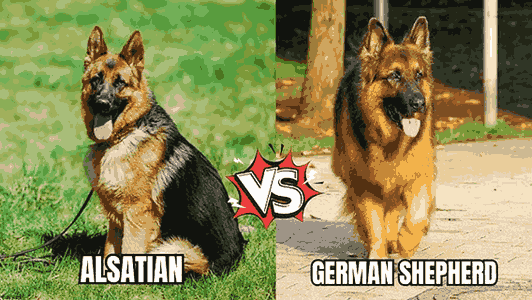
Scroll through Instagram or a rescue site in the UK, and you might see a stunning, wolf-like dog labeled “Alsatian.” Search for the same look on an American breeder’s website, and you’ll find it listed as a “German Shepherd.” If you’ve ever wondered whether these are two related breeds, a regional variant, or something else entirely, here’s the short answer: they’re the exact same dog. No genetic difference, no temperament difference, no separate lineage. What you’re actually looking at is a naming controversy born out of a world war, and understanding it will save you from a genuinely common mix-up when you’re researching, adopting, or talking to breeders.
This matters more than it might seem. Confusion over breed naming has real consequences — people occasionally assume they’re comparing two different dogs with different needs, different temperaments, or different price points, when in reality they’re evaluating identical animals under two different labels. Getting this sorted out upfront means you can focus your research on what actually matters: the dog’s health, temperament, and training needs, rather than chasing a distinction that doesn’t exist.
Quick Overview: Alsatian vs German Shepherd
| Category | Details |
| Breed status | Same breed, two different names |
| Origin | Germany, 1899, developed by Max von Stephanitz |
| Reason for two names | British anti-German sentiment during WWI led to a rebrand |
| “Alsatian” name source | Alsace-Lorraine, a French-German border region |
| Official UK name change back | 1977, reverted to “German Shepherd Dog” |
| Physical differences | None — identical breed standard |
| Temperament differences | None — identical breed traits |
| Common confusion | American Alsatian, a genuinely separate, unrelated breed |
| Where “Alsatian” is still used | Casually in the UK and Ireland, out of habit |
| What actually varies | American vs. European GSD breeding lines, not the name used |
How One Breed Ended Up With Two Names
The story starts in Germany in 1899, when a former cavalry captain named Max von Stephanitz set out to standardize the country’s various regional sheepherding dogs into one consistent, capable breed. He called his creation the Deutscher Schäferhund — German Shepherd Dog — and built a breeding program around intelligence, working ability, and physical soundness rather than appearance alone. That founding philosophy is a big part of why the breed became so versatile decades later, moving from herding sheep into police work, military service, search and rescue, and family companionship.
For about fifteen years, the breed was known consistently by its German name across most of the world. Then World War I broke out, and Britain found itself in a cultural moment where anything associated with Germany became politically and socially uncomfortable. This wasn’t limited to dog breeds either — Britain’s own royal family changed its surname from the German-sounding Saxe-Coburg-Gotha to Windsor during this exact period, specifically to distance the monarchy from its German ancestry. Against that backdrop, calling a popular working dog a “German Shepherd” felt like an unnecessary reminder of the enemy.
So the British Kennel Club made a change. They renamed the breed “Alsatian,” borrowing from Alsace-Lorraine, a region that had passed back and forth between French and German control for generations and carried a neutral, non-German connotation. The new name stuck, and for the better part of six decades, British dog registries, breeders, and owners referred to the breed almost exclusively as the Alsatian.
When Britain Officially Reversed the Name
Here’s a detail that gets left out of a lot of shorter explanations: the “Alsatian” label wasn’t just a wartime nickname that quietly faded. It remained the breed’s official registered name in the UK for a genuinely long stretch — all the way until 1977, when the British Kennel Club formally reverted the name back to German Shepherd Dog. That’s decades after the war that prompted the change had ended, which tells you how deeply the rebrand had settled into everyday British usage.
Even after the official reversal, plenty of British and Irish dog owners kept calling the breed an Alsatian simply out of habit. Older generations in particular grew up with that name as the default, and language tends to lag behind official policy changes by years, sometimes generations. That’s exactly why you’ll still occasionally encounter the term in the UK today, even though every kennel club worldwide now recognizes the breed under its original name.
Is There Any Genuine Difference Between Them?
No — and this is worth stating plainly because it’s the part people most often get wrong. There’s no difference in size, coat, build, temperament, working ability, or genetic background between a dog called an Alsatian and one called a German Shepherd. A veterinarian examining both wouldn’t find anything to distinguish them, because there’s nothing to distinguish. If a breeder or shelter advertises a litter as “Alsatian puppies” and another advertises “German Shepherd puppies” from an identical bloodline, you’re looking at the same dog marketed with two different, historically loaded words.
What does genuinely vary within the breed — and this is likely where some of the lingering confusion comes from — is the difference between American and European breeding lines. American show-line German Shepherds tend to have a more sloped topline, an angled rear stance, and a somewhat more refined head shape, bred largely with conformation showing in mind. European working lines, often favored by police and military units, tend toward straighter backs, a more compact and athletic build, and a notably stronger drive for structured work. Neither of these lines has anything to do with the Alsatian-versus-German Shepherd naming split. They’re simply two different breeding philosophies applied to the same single breed.
Watch Out for the American Alsatian — A Genuinely Separate Breed
This is the detail that trips up even people who’ve done their homework on the naming history. There’s an actual, distinct dog breed called the American Alsatian, and unlike the naming confusion above, this one is genuinely a different animal. Developed in California starting in the 1980s, decades after the original wartime rebrand, the American Alsatian was bred specifically to resemble an extinct prehistoric predator — the dire wolf — a creature that gained significant pop culture attention in more recent years.
The American Alsatian was created using a combination of large, calm breeds and was purpose-built as a gentle, low-energy companion animal, not a working or herding dog. Its temperament, exercise needs, and overall purpose diverge considerably from the high-drive, work-oriented German Shepherd. If you come across a breeder specifically marketing “American Alsatian” puppies, you’re looking at a genuinely different breed than the one this article has otherwise been discussing, and it’s worth treating that distinction seriously rather than assuming it’s just another regional name for the standard German Shepherd.
What This Means If You’re Choosing a Puppy
If you’re evaluating a dog described as either an Alsatian or a German Shepherd, you’re evaluating the identical set of considerations: an intelligent, high-energy, working-line breed that needs consistent training, regular physical exercise, and genuine mental stimulation to thrive in a home environment. Coat length, color, and build can vary meaningfully within the breed itself, but none of that variation correlates with which of the two names a seller happens to use.
What actually matters when you’re choosing a puppy has nothing to do with the naming history and everything to do with practical health and behavior factors: the temperament of both parent dogs, documented hip and elbow scoring to screen for the joint issues this breed is prone to, vaccination and deworming records, and how much early socialization the puppy has already received. A responsible breeder will have this information ready regardless of which name they use to market their litters.
Frequently Asked Questions
Q1. If I see a rescue dog listed as an “Alsatian,” am I actually adopting a German Shepherd?
Yes, genuinely — assuming the listing isn’t specifically referring to the separate American Alsatian breed. In the vast majority of cases, especially outside the US, “Alsatian” simply means German Shepherd, and you should evaluate the dog using the exact same criteria you’d apply to any German Shepherd listing.
Q2. Why do some British and Irish dog owners still say “Alsatian” today if the name officially changed back in 1977?
Language habits tend to outlast official policy changes by a wide margin. Older generations grew up with “Alsatian” as the standard term, and that usage simply carried forward through families and communities even after kennel clubs formally reverted to “German Shepherd Dog.”
Q3. Are American and European German Shepherd lines considered different breeds?
No — they’re the same breed with different breeding emphases. American show lines tend to prioritize a specific look with a sloped topline, while European working lines prioritize physical soundness and drive for structured work like police or military service. Both are genuinely German Shepherds, just bred with different goals in mind.
Q4. How can I tell if a breeder is selling a standard German Shepherd or the separate American Alsatian breed?
Ask directly, and pay attention to how the puppies are described. If a listing specifically emphasizes a calm, low-energy companion temperament and references a “dire wolf” appearance or lineage, you’re likely looking at the American Alsatian rather than a German Shepherd. When in doubt, ask the breeder to clarify which specific breed and lineage they’re working with before making any commitment.