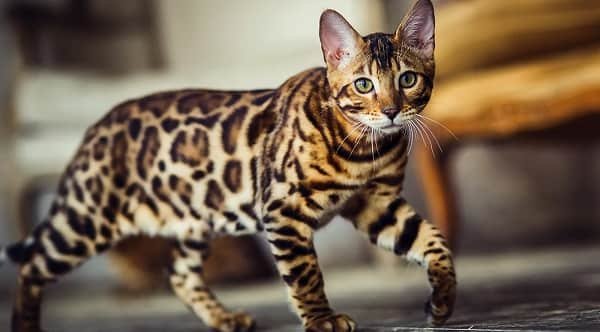
The Bengal cat is the most visually wild-looking domestic cat breed in existence — a breed that carries genuine Asian Leopard Cat ancestry in its genetic makeup and wears it proudly in a coat of spotted or marbled rosettes that creates the unmistakable impression of a miniature leopard living in your living room. Developed in the United States from the 1970s onward through crosses between domestic cats and the Asian Leopard Cat, the Bengal combines the breathtaking appearance of a wild feline with the affectionate, trainable personality of a domestic companion — a combination that has made it one of the world’s fastest-growing pedigreed cat breeds and one of India’s most searched premium cat options in 2026.
In India, the Bengal cat has captured enormous attention through social media content showcasing its glittering spotted coat, athletic build, and distinctly active, engaged personality. If you are searching for the Bengal cat price in India in 2026, this guide provides accurate current pricing across all major cities, the important generation distinctions that significantly affect both price and temperament, the honest health information every buyer needs, and everything required to make a responsible decision about this extraordinary breed.
| Attribute | Details |
| Breed Name | Bengal Cat |
| Origin | USA — Jean Mill crossed domestic cats with Asian Leopard Cat from 1963 |
| Size | Medium-Large: 3.6–7 kg |
| Lifespan | 12–16 years |
| Temperament | Active, intelligent, curious, vocal, playful, affectionate, dog-like |
| Coat | Short, dense, remarkably soft — spotted rosettes or marble pattern |
| Generation Types | F1, F2, F3 (wild hybrids) and SBT (fully domestic — recommended) |
| Eye Colour | Gold, green, or blue (snow Bengals) |
| Price Range (2026) | Rs. 30,000 – Rs. 2,00,000+ |
| TICA Recognition | Full championship status since 1991 |
| Monthly Maintenance | Rs. 4,000 – Rs. 10,000 |
| Best For | Active households, experienced cat owners, large apartments |
| Climate Suitability | Good — short coat well-suited to Indian climate |
| Health Priority | HCM and PRA-b screening of parents — essential |
About the Bengal Cat
The Bengal’s history begins with Dr. Willard Centerwall, a geneticist who in the 1960s crossed domestic cats with Asian Leopard Cats (Prionailurus bengalensis) as part of research into feline leukaemia resistance — Asian Leopard Cats carry natural immunity to certain feline diseases, and the research aimed to transfer this immunity to domestic cats. Jean Mill, a California breeder, acquired some of these hybrids and subsequently developed the Bengal as a domestic breed with the spotted wild-cat appearance while breeding out wild temperament characteristics.
The Asian Leopard Cat — a small wild cat native across South and Southeast Asia including India, Bangladesh, and the Himalayan foothills — gives the Bengal its distinctive spotted coat, its glittering coat quality (a light-reflective characteristic unique to the Bengal among domestic cat breeds), and its athletic, curious temperament. By the fourth generation of domestic breeding, TICA considers Bengals fully domestic cats — though their wild ancestry remains visible in every rosette and every athletic leap.
The Bengal was granted TICA championship status in 1991 and has since grown into one of the world’s most registered pedigreed cats. In India, the Bengal began attracting serious interest from approximately 2016 onward, with established breeding programs in Delhi, Mumbai, and Bangalore producing TICA-registered litters by 2024–2025. The breed’s growing availability has made it more accessible to Indian buyers, though genuine quality specimens remain premium.
Bengal Generations — Critical Information for Indian Buyers
Understanding Bengal generations is the most important knowledge a buyer can have because generations directly affect temperament, domestic suitability, and price.
F1 Bengals are 50% Asian Leopard Cat — direct offspring of a domestic cat and a wild Asian Leopard Cat. These cats retain significant wild temperament characteristics — they are not suitable as conventional pets and require specialist exotic animal management. They are extremely expensive (Rs. 1,50,000–Rs. 3,00,000+) and are inappropriate for typical Indian households.
F2 and F3 Bengals are grandchildren and great-grandchildren of the wild Asian Leopard Cat respectively. They retain more wild characteristics than later generations — less predictable temperament, more demanding management requirements, and higher escape instinct. Not recommended for first-time Bengal owners.
SBT (Stud Book Tradition) Bengals are four or more generations removed from the Asian Leopard Cat — fully domestic by TICA classification. This is the generation that the vast majority of Bengal buyers should be purchasing. SBT Bengals have the breed’s spectacular appearance with fully domestic temperament. When an Indian seller simply says “Bengal cat for sale,” they should be offering SBT animals. Always confirm generation status before purchase.
Bengal Cat Price in India 2026 — City-Wise Breakdown
| City / Category | Min Price (INR) | Max Price (INR) |
| Delhi / NCR | Rs. 35,000 | Rs. 1,20,000 |
| Mumbai | Rs. 38,000 | Rs. 1,30,000 |
| Bangalore | Rs. 30,000 | Rs. 1,10,000 |
| Hyderabad | Rs. 28,000 | Rs. 1,00,000 |
| Chennai | Rs. 25,000 | Rs. 92,000 |
| Kolkata | Rs. 22,000 | Rs. 88,000 |
| Chandigarh / Jaipur | Rs. 28,000 | Rs. 1,00,000 |
| Tier-2 / Tier-3 Cities | Rs. 18,000 | Rs. 65,000 |
| TICA Registered / Show Quality | Rs. 85,000 | Rs. 1,80,000+ |
| F1 / F2 (not recommended for households) | Rs. 1,50,000 | Rs. 3,00,000+ |
| Snow Bengal (rare colour — blue eyes) | Rs. 55,000 | Rs. 2,00,000+ |
Note: Snow Bengals — cats with a pale cream or white base coat combined with the Bengal’s rosette pattern and striking blue eyes — are the rarest and most premium Bengal variety available in India. Three snow variants exist: Seal Lynx Point (lightest), Seal Mink, and Seal Sepia (darkest of the snow range). Always request TICA registration papers confirming SBT status and generation, along with HCM and PRA-b DNA test results for both parents.
Bengal Coat Patterns and Colours
The Bengal’s coat is its most celebrated characteristic and comes in several distinct pattern types. Spotted Rosettes are the most iconic — individual spots arranged in a pattern mimicking the rosettes of a leopard or jaguar, with a darker outline surrounding a lighter interior. Marbled Bengals have a flowing, swirled pattern rather than distinct spots — creating a marble or tie-dye effect that is equally striking. The spotted rosette pattern is more popular in India and typically commands premiums over marbled.
Standard colours include brown tabby (the classic golden-orange base with dark rosettes), silver (pale silver base with dark markings — extremely striking), and the snow variants described above. The glitter characteristic — a light-reflective quality in the coat that makes it appear to sparkle in sunlight — is unique to Bengals among domestic cats and is particularly prized by enthusiasts. Not all Bengals express glitter equally — heavy glitter specimens command significant premiums.
Temperament and Suitability
The Bengal is emphatically not a passive lap cat. It is one of the most active, vocal, and intellectually demanding domestic cat breeds available, and buyers who research the Bengal’s appearance without fully understanding its temperament sometimes find themselves overwhelmed by what they have brought home.
Bengals are genuinely intelligent — they learn household routines faster than most breeds, figure out how to open doors and cabinets, and manipulate their owners with remarkable effectiveness. They are vocal — not with a conventional meow but with a varied repertoire of chirps, trills, and distinctive calls that they use to communicate with their people. They love water — many Bengals will join their owners in the shower, splash in their water bowl enthusiastically, and are fascinated by running taps.
They are highly active — needing substantial daily play with interactive toys, puzzle feeders, and climbing structures to remain psychologically content. A Bengal left in an under-enriched environment becomes destructive, vocal, and increasingly difficult to manage. A tall, multi-level cat tree is not optional — it is a welfare requirement. For Indian apartments, a minimum 2BHK with multiple enrichment stations is appropriate. They are outstanding with children and cat-friendly dogs, forming playful bonds that are deeply entertaining to observe.
Health and Lifespan
The Bengal is generally a robust breed with a 12–16 year lifespan, benefiting from hybrid vigour in its early generations. However, two hereditary conditions are documented and require screening.
Hypertrophic Cardiomyopathy (HCM) — the same progressive heart muscle condition that affects Maine Coons and Ragdolls — occurs in Bengal bloodlines. Annual echocardiographic screening of breeding cats combined with HCM DNA testing (where applicable) is the responsible breeder standard. Request current echocardiogram results for both parents.
Progressive Retinal Atrophy type b (PRA-b) is a hereditary blindness condition specific to Bengals — a DNA test exists and responsible breeders test all breeding cats. PRA-b causes progressive deterioration of the retina leading to complete blindness. Always request PRA-b DNA test certificates confirming both parents are Clear before purchasing any Bengal kitten.
Bengal Progressive Retinal Atrophy (rdAc-PRA) is another hereditary blindness variant — DNA test available. Flat-Chested Kitten Syndrome (FCKS) occasionally occurs in Bengal litters — a developmental chest deformity that ranges from mild and self-resolving to severe.
In India’s climate, the Bengal’s short, dense coat is a genuine advantage — it handles heat significantly better than long-coated breeds without the intensive management requirements of Persian or Ragdoll coats. Standard summer management with AC during peak months is recommended.
Monthly Maintenance Cost in India (2026 Estimate)
| Cost Category | Estimated Cost |
| Premium High-Protein Cat Food | Rs. 2,000 – Rs. 4,500/month |
| Grooming (short coat — minimal) | Rs. 500 – Rs. 1,200/session; monthly |
| Litter and Litter Box | Rs. 600 – Rs. 1,500/month |
| Veterinary Care (annual incl. HCM + eye screening) | Rs. 6,000 – Rs. 16,000 |
| Cat Tree + Interactive Enrichment | Rs. 800 – Rs. 2,000/month amortised |
| Vaccinations & Preventives | Rs. 2,000 – Rs. 4,500 annually |
| Total Estimated Monthly Cost | Rs. 4,000 – Rs. 10,000 |
Frequently Asked Questions (FAQs)
Q1. What is the Bengal cat price in India in 2026?
A: Bengal cat prices from reputable Indian breeders in 2026 range from Rs. 22,000 to Rs. 1,30,000 for SBT domestic Bengals depending on city, coat pattern, colour, and documentation. TICA-registered show-quality Bengals from HCM and PRA-b screened parents start at Rs. 85,000. Snow Bengals with blue eyes range from Rs. 55,000 to Rs. 2,00,000+. F1 and F2 generation Bengals (not recommended for households) reach Rs. 1,50,000–Rs. 3,00,000+.
Q2. Is the Bengal cat legal to own in India?
A: SBT Bengals — four or more generations removed from the Asian Leopard Cat — are fully domestic cats and entirely legal to own in India. F1 Bengals (50% Asian Leopard Cat) may fall under Wildlife Protection Act provisions given the Asian Leopard Cat’s protected status in India. Any Bengal purchased in India should be SBT generation — confirmed in writing by the breeder — to ensure complete legal clarity.
Q3. What is the “glitter” characteristic in Bengal cats?
A: The glitter is a remarkable light-reflective quality in the Bengal’s coat — individual hairs have a translucent tip that catches and reflects light, making the coat appear to sparkle in sunlight as though dusted with gold or pearl. This characteristic is unique to Bengal cats among domestic breeds and is most visible in natural light. Not all Bengals express glitter equally — heavily glittered specimens where the entire coat sparkles are the most prized and command significant premiums from serious enthusiasts.
Q4. Do Bengal cats need a lot of attention?
A: Yes — the Bengal is one of the most attention-demanding domestic cat breeds. They are highly intelligent, extremely active, and genuinely social. Without adequate daily interactive play (minimum 30–45 minutes of active engagement), mental stimulation through puzzle feeders and enrichment, and human company, Bengals become vocally demanding and destructive. They thrive with a companion cat, particularly another Bengal or active breed, to provide company during working hours.
Q5. How does the Bengal cat compare to a domestic shorthair in India?
A: The Bengal offers a dramatically more visually spectacular coat, significantly higher intelligence and trainability, and a more engaged, interactive personality than a typical domestic shorthair. However, it requires considerably more enrichment, activity, and mental engagement. A domestic shorthair or Indian cat is more self-sufficient, lower-maintenance, and equally affectionate for owners who want a calmer companion. The Bengal is the right choice for active, engaged owners who want a genuinely interactive feline partner rather than an independent companion.