The Savannah cat is the closest thing to a wild cat that domestic ownership can legally and ethically offer — a stunning, long-legged, spotted hybrid between the African Serval and a domestic cat that combines the visual impact of a miniature cheetah with the affectionate, loyal temperament that has made it one of the world’s most remarkable pedigreed cat breeds. Recognised by TICA since 2001, the Savannah has grown from a curiosity into a coveted premium breed that consistently attracts buyers willing to pay substantial sums for the extraordinary combination of wild aesthetics and domestic compatibility.
In India, the Savannah cat is one of the rarest and most expensive cat breeds available — a specialist purchase for serious enthusiasts who understand both the breed’s extraordinary qualities and the important legal, generation-specific, and management considerations that responsible Savannah ownership demands. This guide provides accurate 2026 pricing, complete generation information, the honest legal context for India, health facts, and everything needed to make an informed decision about the world’s largest domestic cat breed.
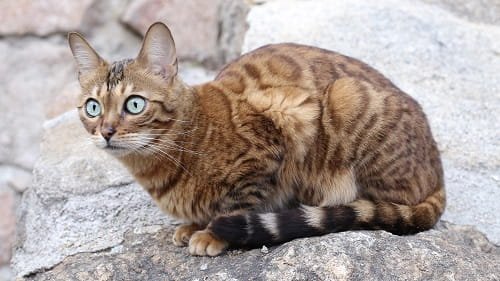
| Attribute | Details |
| Breed Name | Savannah Cat |
| Created By | Judee Frank — first documented cross 1986; breed developed by Patrick Kelly and Joyce Sroufe |
| TICA Recognition | Full championship status since 2012 |
| Wild Parent | African Serval (Leptailurus serval) |
| Largest Domestic Cat | F1 Savannahs can reach 11–14 kg — taller than most domestic cats |
| Generation Types | F1 (50% Serval), F2, F3, F4, SBT (fully domestic) |
| Size Decreases | Each generation removes further from Serval — smaller and more domestic |
| Price Range (2026) | Rs. 80,000 – Rs. 4,00,000+ |
| TICA Show Quality | Rs. 1,50,000 – Rs. 3,00,000+ |
| Monthly Maintenance | Rs. 7,000 – Rs. 18,000 |
| Legal Status India | SBT safe; early generations legally complex — seek legal advice |
| Best For | Experienced exotic cat owners; large apartment or house with enrichment |
| Climate Suitability | Good — lean build and short coat handle Indian climate well |
About the Savannah Cat
The Savannah cat’s formal history begins in 1986 when Judee Frank, an American breeder, documented the first successful Serval-domestic cat cross — a female kitten named “Savannah” born to a Serval father and Siamese domestic mother. Patrick Kelly, who purchased one of Savannah’s offspring, subsequently partnered with breeder Joyce Sroufe to develop the Savannah as a formal pedigreed breed, writing the first breed standard and working toward TICA recognition. The breed received preliminary TICA recognition in 2001 and full championship status in 2012.
The African Serval — the wild parent — is a medium-sized African wild cat weighing 8–18 kg, famous for having the largest ears relative to body size of any cat in the world, extraordinarily long legs that allow it to leap 3–4 metres vertically to catch birds, and a spotted coat of remarkable beauty. The Serval’s physical characteristics — particularly its long legs, large ears, and spotted coat — are the primary visual contributions to the Savannah breed, creating a domestic cat of extraordinary height and wild appearance.
In India, genuine Savannah cats are extremely rare. The breed’s high cost, complex legal status for early generations, and management requirements make it a genuine specialist acquisition. By 2024–2025, a very small number of Indian importers and breeders have begun working with SBT Savannah cats, though early generation (F1-F3) individuals are essentially not commercially available through domestic Indian breeding programs.
Savannah Cat Price in India 2026 — By Generation
| Generation | Serval % | Price Range (India) | Household Suitability |
| F1 Savannah | 50% Serval | Rs. 2,50,000 – Rs. 4,00,000+ | Experienced exotic handlers only |
| F2 Savannah | 25% Serval | Rs. 1,50,000 – Rs. 2,80,000 | Experienced handlers |
| F3 Savannah | 12.5% Serval | Rs. 1,20,000 – Rs. 2,00,000 | Motivated experienced owners |
| F4 Savannah | ~6% Serval | Rs. 1,00,000 – Rs. 1,60,000 | Experienced cat owners |
| SBT Savannah (4+ generations) | Fully domestic | Rs. 80,000 – Rs. 1,50,000 | Recommended for most buyers |
| TICA Show Quality SBT | Fully domestic | Rs. 1,50,000 – Rs. 3,00,000+ | Best documented quality |
Note: All Savannah prices in India include significant import cost components for most available individuals — domestic Indian breeding of Savannahs is extremely limited. Import costs add Rs. 60,000–Rs. 1,20,000 beyond the cat’s purchase price.
Legal Status in India — Critical Information
The legal status of Savannah cats in India requires careful attention and specific legal advice before purchase. The African Serval is listed under CITES Appendix II — international trade in Servals and their direct hybrids requires documentation. Indian Wildlife Protection Act provisions may apply to early generation Savannahs (F1, F2, F3) as recent wild-animal hybrids.
SBT Savannahs — classified as fully domestic by TICA after four or more generations of domestic-only breeding — are generally considered legally equivalent to domestic cats in most contexts. However, Indian wildlife law interpretation varies and specific legal advice from a specialist in Indian wildlife legislation is strongly recommended before purchasing any Savannah cat, particularly early generation individuals.
Temperament and Suitability
The Savannah’s temperament reflects its generation — early generation cats (F1, F2) are significantly more challenging than later generations, retaining wild cat characteristics including heightened flight responses to strangers, territorial scent marking, and management requirements beyond conventional domestic cats. F1 Savannahs are genuinely not appropriate for most households regardless of experience.
SBT Savannahs have fully domestic temperaments that retain the breed’s characteristic intelligence, athletic activity, and loyal dog-like bonding with their primary person. They are extraordinarily active — requiring substantial vertical space (tall cat trees are essential), interactive daily play, and preferably a companion animal. They are not independent lap cats — they demand and give engagement with genuine intensity. They walk confidently on harnesses, play fetch with retrieval instinct, and learn household routines with impressive speed.
For Indian apartment living, a minimum 2BHK with a dedicated tall cat tree, multiple enrichment stations, and daily interactive play commitment is necessary. SBT Savannahs are genuinely manageable in well-enriched Indian apartments; early generation individuals are not appropriate for typical apartment environments.
Health and Lifespan
Savannah cats are generally healthy with a lifespan of 12–20 years. HCM cardiac screening of breeding cats is important — request current echocardiogram results. Servals and early generation Savannahs may require a raw or high-protein diet that more closely reflects wild cat nutritional profiles — discuss with an experienced exotic cat veterinarian. Progressive Retinal Atrophy (PRA) is documented in some Savannah bloodlines. Finding a veterinarian in India with exotic cat hybrid experience is important for early generation individuals.
Monthly Maintenance Cost in India (2026 Estimate)
| Cost Category | Estimated Cost |
| Premium High-Protein Cat Food | Rs. 3,000 – Rs. 6,500/month |
| Enrichment — Tall Cat Trees, Interactive Toys | Rs. 1,500 – Rs. 3,000/month amortised |
| Veterinary Care (annual) | Rs. 10,000 – Rs. 22,000 |
| Litter and Litter Box | Rs. 700 – Rs. 1,800/month |
| Vaccinations & Preventives | Rs. 2,500 – Rs. 5,500 annually |
| Total Estimated Monthly Cost | Rs. 7,000 – Rs. 18,000 |
Frequently Asked Questions (FAQs)
Q1. What is the Savannah cat price in India in 2026?
A: Savannah cat prices in India in 2026 range from Rs. 80,000 for SBT fully domestic generation individuals to Rs. 4,00,000+ for F1 early generation cats. TICA show-quality SBT Savannahs start at Rs. 1,50,000. Import costs add Rs. 60,000–Rs. 1,20,000 to most Indian acquisitions. Most buyers should target SBT generation for best domestic compatibility.
Q2. What generation of Savannah cat is best for an Indian household?
A: SBT (Stud Book Tradition) Savannahs — four or more generations removed from the African Serval — are the most appropriate for Indian households. They are fully domestic in TICA classification, retain the breed’s extraordinary appearance and personality, are legally safest in India, and are the most manageable for experienced but non-specialist cat owners. F1 and F2 generations are strictly for experienced exotic animal handlers with appropriate facilities.
Q3. How big does a Savannah cat get?
A: Generation significantly affects size. F1 Savannahs can reach 11–14 kg and stand 45–60 cm at the shoulder — genuinely the size of a medium dog. SBT Savannahs are typically 4–8 kg — still larger than average domestic cats, with notably long legs and large ears that retain visual wild-cat impact. The Savannah holds the Guinness World Record for tallest domestic cat.
Q4. Is the Savannah cat the same as the Ashera?
A: Yes — DNA testing proved that the Ashera, marketed as a unique breed by Lifestyle Pets from 2006–2008 at USD 22,000–125,000, was genetically identical to Savannah cats. The company reportedly purchased Savannah kittens and resold them under the fabricated Ashera brand. The Savannah is the genuine breed — TICA-recognised, properly documented, and available through legitimate breeding channels.
Q5. Does the Savannah cat need a special diet in India?
A: SBT Savannahs can thrive on premium commercial high-protein cat food — the same quality food appropriate for any active pedigreed cat. Early generation Savannahs (F1, F2) may benefit from raw or prey-model diets that more closely match wild cat nutritional requirements. Consult with a veterinarian experienced in exotic cat hybrids for early generation dietary guidance. For SBT individuals, the primary dietary requirement is simply high-quality protein from reputable premium cat food brands available in India.