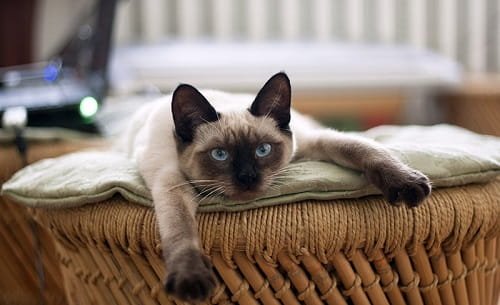
The Siamese cat is one of the oldest, most recognisable, and most vocal cat breeds in the world — an ancient Thai royal breed whose distinctive pointed colouration, sapphire blue eyes, and extraordinarily communicative personality have made it one of the most beloved and most discussed cats in human history. Known as the “Wichian Mat” (Moon Diamond) in its native Thailand, the Siamese has been documented in Thai royal palace manuscripts dating back to the 14th century, making it one of the most genuinely ancient pedigreed cat breeds in existence.
In India’s cat market of 2026, the Siamese occupies a fascinating position — it is one of the most affordable premium cat breeds available, with genuine pedigreed individuals accessible at relatively modest prices compared to Maine Coons or Bengals, while offering a temperament and personality so distinctive that experienced Siamese owners describe it as genuinely addictive. This guide covers accurate 2026 pricing, the important traditional versus modern type distinction, health information, and the honest temperament reality that every prospective Siamese owner must understand.
| Attribute | Details |
| Breed Name | Siamese Cat (Wichian Mat) |
| Origin | Thailand (Siam) — documented from 14th century |
| Size | Medium: 3.5–5 kg, elongated and athletic |
| Lifespan | 15–20 years — one of the longest-lived cat breeds |
| Temperament | Extremely vocal, affectionate, demanding, intelligent, social, dog-like |
| Coat | Short, fine, glossy — always colourpoint pattern |
| Eye Colour | Always vivid blue — a defining characteristic |
| Types | Traditional (Apple Head) and Modern (Wedge Head) |
| Price Range (2026) | Rs. 10,000 – Rs. 80,000 |
| Monthly Maintenance | Rs. 2,500 – Rs. 7,000 |
| Best For | Experienced cat owners, households with regular human company |
| Vocality Warning | Extremely vocal — genuinely unsuitable for noise-sensitive apartment buildings |
| Climate Suitability | Excellent — short coat perfectly suited to Indian climate |
About the Siamese Cat
The Siamese cat appears in the “Tamra Maew” (The Cat Book Poems) — an ancient Thai manuscript from the Ayutthaya Kingdom (1351–1767 AD) that depicts and describes auspicious cat breeds kept by Thai royalty. These manuscripts, some of which are now housed in Bangkok’s National Library, represent the earliest documented evidence of specific cat breed cultivation anywhere in the world. The Siamese was considered a sacred cat in Thai culture — kept in temples and royal palaces, believed to carry the souls of deceased royalty before their reincarnation.
The breed reached Western consciousness when the British Consul-General in Bangkok received a pair of Siamese cats as a gift from the King of Siam in 1884, subsequently exhibiting them at the Crystal Palace cat show in London where they caused immediate sensation. The Siamese has been one of the most influential breeds in cat fancy history — it contributed to the development of numerous modern breeds including the Himalayan (Persian-Siamese cross), Birman, Tonkinese, Balinese (longhaired Siamese), and Colourpoint British Shorthair.
An important distinction for Indian buyers: the Traditional Siamese (also called Apple Head or Thai Siamese) has a rounder, more moderate head and body structure resembling the original Thai cats. The Modern Siamese has an extremely elongated, wedge-shaped head, large ears, and a very angular body — the result of decades of show-ring selection for extreme type. Traditional Siamese are generally considered healthier, with fewer respiratory and dental issues from the less extreme head structure.
Siamese Cat Price in India 2026 — City-Wise Breakdown
| City / Category | Min Price (INR) | Max Price (INR) |
| Delhi / NCR | Rs. 12,000 | Rs. 65,000 |
| Mumbai | Rs. 14,000 | Rs. 70,000 |
| Bangalore | Rs. 10,000 | Rs. 58,000 |
| Hyderabad | Rs. 10,000 | Rs. 55,000 |
| Chennai | Rs. 8,000 | Rs. 50,000 |
| Kolkata | Rs. 8,000 | Rs. 48,000 |
| Tier-2 / Tier-3 Cities | Rs. 5,000 | Rs. 30,000 |
| TICA / CFA Registered / Show Quality | Rs. 45,000 | Rs. 80,000+ |
| Traditional / Apple Head Type | Rs. 15,000 | Rs. 60,000 |
Colour Points Available
The four classic Siamese colour points are Seal Point (dark brown-black points on pale fawn body — most iconic), Blue Point (steel grey points on cold white body), Chocolate Point (milk chocolate points on ivory body), and Lilac Point (pinkish-grey points on glacial white body — rarest and most premium). Modern registries also accept Flame, Cream, Tortie, and Lynx (tabby) points in what is sometimes called the Colourpoint Shorthair. In India, Seal Point is most widely available; Lilac Point commands the highest premium.
Temperament and Suitability
The Siamese temperament deserves the most honest possible description: this is the most demanding, most social, and most vocal domestic cat breed in existence. Siamese cats do not simply meow — they hold conversations, express opinions, demand responses, and will not accept being ignored. Their vocalisation is legendary — a loud, low-pitched, insistent “meezer” call that is utterly distinctive and utterly relentless when they want attention.
They bond with extraordinary intensity to their primary person and can develop separation anxiety when consistently left alone. They are genuinely social animals that thrive with a companion cat (ideally another Siamese) or in a household where human presence is regular throughout the day. Their intelligence is exceptional — they learn their owner’s routines, manipulate situations to their advantage, and remember perceived injustices with impressive precision.
For Indian apartments in buildings with noise-sensitive neighbours, the Siamese vocality is a genuine management consideration. For households that want the most intensely engaged, communicative, emotionally present cat companion possible, the Siamese is unmatched.
Health and Lifespan
The Siamese is one of the longest-lived cat breeds — regularly reaching 15–20 years. Hereditary conditions include Amyloidosis (protein deposits in organs — predominantly in the Siamese), Progressive Retinal Atrophy (PRA — DNA test available), and convergent strabismus (crossed eyes — benign in Siamese, a breed characteristic rather than a defect). Modern-type Siamese have elevated rates of respiratory and dental issues from extreme head structure.
In India’s climate, the Siamese’s short, fine coat is genuinely excellent — requiring minimal grooming and handling India’s heat better than virtually any other pedigreed breed.
Monthly Maintenance Cost in India (2026 Estimate)
| Cost Category | Estimated Cost |
| Premium Cat Food | Rs. 1,500 – Rs. 3,500/month |
| Grooming (minimal — weekly brushing only) | Rs. 400 – Rs. 900/session; monthly |
| Litter and Litter Box | Rs. 500 – Rs. 1,200/month |
| Veterinary Care (annual) | Rs. 4,000 – Rs. 12,000 |
| Vaccinations & Preventives | Rs. 1,500 – Rs. 3,500 annually |
| Total Estimated Monthly Cost | Rs. 2,500 – Rs. 7,000 |
Frequently Asked Questions (FAQs)
Q1. What is the Siamese cat price in India in 2026?
A: Siamese cat prices range from Rs. 8,000 for undocumented traditional-type individuals in tier-2/3 cities to Rs. 70,000 for TICA-registered show-quality modern-type cats in metro cities. Traditional Apple Head Siamese from reputable breeders range Rs. 15,000–Rs. 60,000. Lilac Point commands the highest colour premium. The Siamese is one of India’s most accessible pedigreed cat breeds.
Q2. Why are Siamese cats so vocal?
A: Siamese vocality is a genuine breed characteristic — not excessive meowing but a communicative, social vocalisation style that reflects the breed’s extraordinarily social nature. Siamese were bred in close proximity to Thai royalty and developed an intense orientation toward human communication. Their distinctive “meezer” call is lower-pitched and more resonant than typical cat meowing. This vocality is inseparable from the Siamese personality — buyers should consider it a feature rather than a problem.
Q3. What is the difference between Traditional and Modern Siamese?
A: Traditional (Apple Head) Siamese have rounder heads, less extreme body structure, and more moderate ear size — resembling the original Thai cats. Modern (Wedge Head) Siamese have dramatically elongated wedge-shaped heads, very large ears, and an angular body — bred to extremes for show ring aesthetics. Traditional types are generally healthier with fewer structural health issues. Both types have identical colourpoint pattern and blue eyes.
Q4. Are Siamese cats good for Indian apartments?
A: Yes, with one significant caveat — their vocality. In Indian apartment buildings where walls are thin and neighbours are close, the Siamese’s persistent, loud vocalisation can create genuine neighbourly friction. In larger apartments, bungalows, or buildings with reasonable acoustic separation, the Siamese is an outstanding apartment cat. Their short coat, moderate size, and indoor temperament all suit Indian apartment life perfectly.
Q5. Do Siamese cats need a companion?
A: Strongly recommended. The Siamese’s intense social nature means they do not do well with extended isolation. A companion cat — ideally another Siamese or similarly social breed — significantly improves their welfare during working hours. Two Siamese cats together provide each other with the constant social engagement their nature demands, often forming lifelong bonds of remarkable closeness.