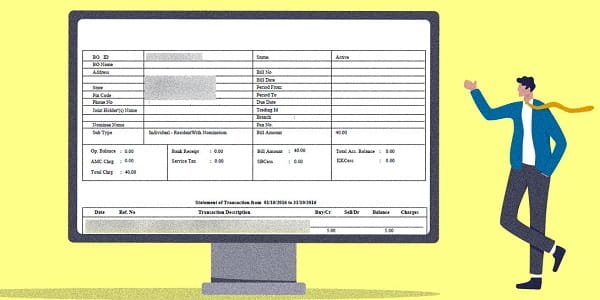
Your Demat account balance summary statement is the authoritative record of what you own — shares, mutual fund units, ETFs, bonds, and any other securities held in your account. When this statement shows an error — an unexpected missing position, an incorrectly stated quantity, a security you don’t recognise appearing in your holdings, or a balance that doesn’t match your transaction records — the instinct is often either immediate alarm or extended procrastination.
Neither response is optimal. Understanding how errors occur, how to verify them, and which resolution pathway to follow converts an alarming situation into a manageable process with defined steps and predictable timelines.
First: Confirm It’s Actually an Error
Before initiating any complaint process, confirm that what appears to be an error isn’t a discrepancy between statement timing and transaction processing.
Demat account statements reflect positions as of a specific date and settlement cycle. A share purchased today isn’t settled into your Demat account until T+1 — the next trading day. A mutual fund unit purchased through SIP on a given date may take one to two business days to appear in the Demat statement. An IPO allotment credit may arrive days after the allotment date depending on the issue’s administrative timeline.
Download a fresh statement covering the most recent available date and compare it against your transaction confirmation records. Confirm the settlement date for any recently purchased security before concluding that its absence is an error rather than a pending credit.
Types of Errors and Their Likely Sources
Understanding the type of error you’re dealing with helps direct the complaint to the correct party.
Missing holdings or incorrect quantities — securities that should be present but aren’t, or quantities that differ from your purchase records — are typically errors at the Depository Participant level, which is your broker. The DP is responsible for accurately crediting securities to your account following settlement instructions from the clearing corporation.
Unrecognised securities appearing in your account — positions you didn’t purchase and don’t recognise — require a different response. This could represent a corporate action credit — a bonus share, a rights issue, or a merger allotment — that you hadn’t anticipated. It could also indicate an error in an inter-DP transfer where securities were credited to your account by mistake. In the rare and serious scenario, it could indicate an unauthorised transfer that needs immediate security escalation.
Valuation discrepancies — where the value shown for a known holding doesn’t correspond to the current market price — are typically display or calculation issues in the broker’s portfolio interface rather than errors in the Demat record itself. The Demat record stores quantity, not value — valuation is a derived calculation based on market data applied to the quantity record.
Step 1: Compare Your Statement Against the Depository’s Authoritative Record
Your broker’s platform displays the Demat holdings, but it is not the authoritative record. The authoritative record is maintained at the depository level — CDSL or NSDL.
Access CDSL’s Easi portal or NSDL’s SPEED-e system directly — these are the depositories’ own investor access platforms — and download the statement directly from the depository source. This statement reflects the depository’s own record independent of your broker’s display.
If the depository’s statement matches your broker’s statement, the discrepancy is between both records and your transaction records — suggesting either a settlement failure or a transaction recording error. If the depository’s statement differs from your broker’s statement, the broker’s display has an error that the depository’s accurate record can resolve.
Step 2: Check Your Contract Notes and Transaction Statements
Every securities transaction generates a contract note — a legally binding document from your broker confirming the trade details including security name, quantity, price, and settlement date. For mutual fund purchases, allotment statements serve the equivalent function.
Compile your contract notes and allotment statements for the securities involved in the discrepancy. This documentation constitutes the evidentiary basis for your complaint — the specific transactions that should have resulted in holdings that are absent or different from what the statement shows.
Step 3: Raise a Complaint With Your Broker’s Customer Service
Initiate a formal written complaint — email rather than phone call, to create a documented paper trail — with your broker’s customer service team. Include your account number, the specific error description with dates, the relevant contract notes or transaction references, and a clear statement of what correction you are requesting.
Most routine Demat statement errors — missing credits from corporate actions, quantity discrepancies from processing delays — are resolved within three to seven business days through the broker’s back-office reconciliation process. Request a specific timeline commitment in the initial response.
Step 4: Escalate Through the Regulatory Pathway If Unresolved
If the broker’s customer service doesn’t resolve the error within the promised timeline or provides an unsatisfactory response, escalate through the formal regulatory pathway.
File a complaint with the relevant stock exchange — NSE or BSE — through their investor complaint mechanism. The exchange has oversight responsibility for its member brokers and can compel a response that customer service timelines may not deliver.
For complaints that remain unresolved after exchange-level escalation, SEBI’s SCORES platform — the Securities and Exchange Board of India’s Complaints Redress System — allows complaint registration against regulated entities with SEBI’s monitoring of the resolution process.
When a Discrepancy Is Potentially Fraudulent
If unrecognised securities have appeared in your account, or if you discover a transfer or pledge of your securities that you didn’t authorise, escalate immediately — don’t wait for the standard resolution timeline.
Contact your broker immediately to freeze all debit transactions on the account pending investigation. File a complaint with SEBI SCORES and with the cyber crime cell. Simultaneously, the depository — CDSL or NSDL — can be contacted directly through their investor helplines for unauthorised transaction reporting. Speed is critical in suspected fraud scenarios — the sooner the account is frozen and the complaint is filed, the greater the probability of recovery.
Frequently Asked Questions (FAQs)
Q1. How often should I check my Demat account statement for errors?
A: Monthly review of your Demat account statement — either from your broker’s platform or directly from the depository — is a reasonable minimum for active investors. Annual or event-triggered review — after each IPO allotment, corporate action, or significant transaction — is the minimum for passive long-term investors. Errors are most easily resolved when identified promptly — a discrepancy discovered months after it occurred is harder to investigate and resolve than one identified within days.
Q2. My bonus share allotment doesn’t appear in my Demat statement two weeks after the record date. Is this an error?
A: Bonus share credits from the record date can take two to three weeks to appear in Demat accounts as the company processes the corporate action through its RTA — Registrar and Transfer Agent — and the depository. If the credit hasn’t appeared after three weeks from the record date, contact your broker with the record date and bonus ratio details to initiate a follow-up with the company’s RTA. This is a delayed credit rather than necessarily an error, but follow-up is appropriate after the standard processing window.
Q3. Can I get compensation if a broker’s error results in financial loss — for example, if missing shares meant I couldn’t sell during a price peak?
A: Consequential loss claims — losses arising from a broker’s failure rather than directly from the broker taking your money — are complex to pursue. Stock exchange arbitration and civil legal action are the available mechanisms, but establishing causation and quantum of loss requires evidence beyond the mere fact of the error. SEBI’s investor protection framework focuses on direct losses — securities taken without authorisation, fees charged incorrectly — more than consequential opportunity losses. Document everything meticulously and consult a securities lawyer if the consequential loss is material.
Q4. What is the correct approach if my Demat statement shows shares in a company that has since been delisted?
A: Delisted shares may continue to appear in your Demat statement — delisting removes a company from exchange trading but doesn’t automatically extinguish the share holding. The shares remain in your account until either the company conducts a buyback, a court-ordered scheme of arrangement provides exit, or you identify a willing buyer through an off-market transfer. Contact your broker to understand the delisted company’s current status — voluntary delisting with a compulsory exit offer, regulatory suspension, or winding up — to determine what exit options if any are available for your specific holding.
Q5. If I find an error in my consolidated account statement from NSDL or CDSL rather than my broker’s statement, who do I contact first?
A: The CAS from NSDL or CDSL reflects the depository’s own records — so an error in this statement indicates a discrepancy in the authoritative source itself. Contact your broker first, as the DP is the intermediary responsible for ensuring accurate records in the depository. The DP can initiate a correction request with the depository for verified errors. For errors the DP cannot explain or resolve, contact the depository’s investor helpline directly — NSDL and CDSL both maintain investor grievance cells for exactly these situations.
The Bottom Line
All three articles in this set address the verification and error management disciplines that protect financial relationships and investment portfolios from the risks that exist within them. Verifying an MFI’s registration before borrowing is the five-minute process that separates formal, regulated credit access from unprotected exposure to predatory lending. Sectoral mutual fund evaluation requires holding both the opportunity analysis and the risk analysis simultaneously — understanding that the same concentration that amplifies gains amplifies losses, and that timing is as important as thesis. And Demat account error resolution has a clear pathway — verify against the authoritative depository source, document thoroughly, escalate through defined channels, and act with urgency when the error suggests potential fraud. In each case, the informed response produces outcomes categorically better than either alarm or inaction.