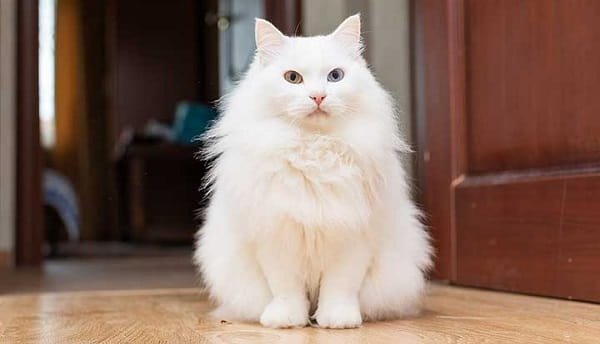
The Turkish Angora is one of the oldest and most naturally beautiful cat breeds in the world — a lean, elegant, silky-coated cat from the Ankara region of Turkey whose flowing white coat, plumed tail, and startling eyes (often the odd-eyed combination of one blue and one amber) have made it one of the most visually distinctive domestic cats in existence. Unlike many modern breeds developed through deliberate human crossing programs, the Turkish Angora is a naturally occurring breed that evolved in the mountainous Ankara region over centuries — a cat whose beauty is the product of nature rather than selective breeding for exaggerated features.
In India’s growing premium cat market of 2026, the Turkish Angora is rare but increasingly recognised — appealing particularly to buyers who want a naturally beautiful longhaired cat without the intensive mat-prone grooming demands of the Persian, and with a significantly more active, playful, and engaged personality than the Persian’s serene passivity. This guide covers accurate 2026 pricing, the fascinating Ankara Zoo breeding program that saved the breed, the genetics of odd-eyes, and complete health information.
| Attribute | Details |
| Breed Name | Turkish Angora |
| Origin | Ankara (formerly Angora), Turkey — natural breed |
| Size | Medium: 3–5 kg, lean and elegant |
| Lifespan | 12–18 years |
| Temperament | Playful, intelligent, social, athletic, affectionate, opinionated |
| Coat | Long, single silky coat — white most iconic; all colours accepted |
| Famous Feature | Odd eyes (one blue, one amber) — particularly in white individuals |
| Price Range (2026) | Rs. 25,000 – Rs. 1,00,000 |
| TICA / CFA Show Quality | Rs. 60,000 – Rs. 1,00,000+ |
| Monthly Maintenance | Rs. 3,500 – Rs. 8,500 |
| Best For | Active households, experienced cat owners, those wanting natural elegance |
| Climate Note | Single coat handles Indian climate better than Persian |
| Ankara Zoo | Turkish government breeding program preserves purebred stock |
About the Turkish Angora
The Turkish Angora’s history in Ankara spans centuries — these elegant white cats were documented by European travellers to Turkey from the 16th century onward, with French scientist Pierre Gilles describing white longhaired cats in the Ankara region in 1555. The name “Angora” derives from the city’s former name and also gave its name to other Angora breeds — Angora goats, Angora rabbits — all sharing the Ankara region’s characteristic long, silky fibre.
The breed contributed significantly to early cat fancy in Europe — Angora cats were among the first longhaired cats imported to Britain and France in the late 17th and 18th centuries, becoming fashionable among European aristocracy. As Persian cats were subsequently imported and gained dominance in cat shows due to their more extreme, dramatic appearance, the Turkish Angora’s popularity declined and the breed became nearly extinct outside Turkey.
The Turkish government recognised the breed’s cultural and natural heritage significance and established a protected breeding program at Ankara Zoo specifically to preserve the pure white, odd-eyed Turkish Angora — considered Turkey’s most prestigious natural breed. This Ankara Zoo program continues to this day as of 2025–2026, maintaining a controlled population of pure Turkish Angoras under government protection. The zoo does not export, but the existence of the program has supported international breed recognition and inspired breeders worldwide to establish their own programs from the Turkish Angora stock that reached North America and Europe in the mid-20th century.
Turkish Angora Price in India 2026 — City-Wise Breakdown
| City / Category | Min Price (INR) | Max Price (INR) |
| Delhi / NCR | Rs. 28,000 | Rs. 88,000 |
| Mumbai | Rs. 30,000 | Rs. 95,000 |
| Bangalore | Rs. 25,000 | Rs. 82,000 |
| Hyderabad | Rs. 22,000 | Rs. 78,000 |
| Chennai / Kolkata | Rs. 20,000 | Rs. 72,000 |
| Tier-2 / Tier-3 Cities | Rs. 14,000 | Rs. 48,000 |
| TICA / CFA Registered Show Quality | Rs. 60,000 | Rs. 1,00,000+ |
| Imported — Turkey / USA / Europe | Rs. 80,000 | Rs. 1,30,000+ |
| White Odd-Eyed (premium combination) | Rs. 40,000 | Rs. 1,00,000+ |
The Odd-Eyed Turkish Angora
The odd-eyed Turkish Angora — one blue eye and one amber eye — is one of the most immediately striking visual combinations in the entire domestic cat world and is the most iconic expression of the breed. This heterochromia (two different coloured eyes) is caused by unequal melanin distribution during embryonic development — one eye receives sufficient melanin to produce amber/copper colouration while the other does not, remaining blue.
A genetic reality worth noting: white cats with blue eyes have elevated rates of congenital deafness — the same pigmentation gene that produces white coat and blue eyes also affects melanocytes in the inner ear responsible for hearing development. White cats with two blue eyes have the highest deafness risk. Odd-eyed white cats (one blue, one amber) typically have normal hearing in the ear on the amber-eye side and may have unilateral deafness on the blue-eye side. BAER (Brainstem Auditory Evoked Response) testing is recommended for white Turkish Angora kittens before purchase. Unilateral deafness does not prevent a normal, active life but buyers should be informed.
Temperament and Suitability
The Turkish Angora’s temperament contrasts sharply with the Persian’s serene passivity — these are active, athletic, opinionated cats that enjoy climbing, jumping, playing, and participating in household activities with genuine enthusiasm. They are intelligent and curious, investigating new objects with the confident boldness of a breed that has never been bred for passivity. They form close bonds with their primary person while maintaining enough independence to manage working-hour solitude.
They are vocal — expressing opinions on household events with a distinctive, medium-pitched vocalisation that is assertive without the Siamese’s relentless persistence. They enjoy interactive play enthusiastically throughout their long lives, remaining playful into old age. For active Indian households that want a naturally elegant, athletically capable cat with genuine personality, the Turkish Angora is outstanding.
Health and Lifespan
The Turkish Angora is a naturally evolved breed with generally excellent health — one of the healthiest longhaired breeds available. HCM occurs but at lower rates than in many modern developed breeds. The primary specific concern is the deafness risk in white individuals — BAER testing is important. Ataxia (hereditary neurological disorder causing loss of coordination) is documented in some Turkish Angora bloodlines — responsible breeders screen for this condition.
The single silky coat is one of the most climate-practical in the longhaired category for India — significantly less prone to matting than the Persian’s dense double coat and managing Indian humidity better. Weekly brushing and professional grooming every 6–8 weeks maintains it beautifully.
Monthly Maintenance Cost in India (2026 Estimate)
| Cost Category | Estimated Cost |
| Premium Cat Food | Rs. 1,800 – Rs. 4,000/month |
| Professional Grooming (single silky coat) | Rs. 900 – Rs. 2,000/session; every 6–8 weeks |
| Litter and Litter Box | Rs. 500 – Rs. 1,200/month |
| Veterinary Care (annual) | Rs. 5,000 – Rs. 14,000 |
| Vaccinations & Preventives | Rs. 2,000 – Rs. 4,500 annually |
| Total Estimated Monthly Cost | Rs. 3,500 – Rs. 8,500 |
Frequently Asked Questions (FAQs)
Q1. What is the Turkish Angora price in India in 2026?
A: Turkish Angora prices from reputable breeders in India in 2026 range from Rs. 20,000 to Rs. 95,000. White odd-eyed individuals command premiums of Rs. 40,000–Rs. 1,00,000+. TICA or CFA-registered show quality cats start at Rs. 60,000. Turkish or European imports reach Rs. 80,000–Rs. 1,30,000+ including import costs.
Q2. What is the Ankara Zoo breeding program?
A: The Turkish government established a protected breeding program at Ankara Zoo specifically to preserve the pure white, odd-eyed Turkish Angora — considered Turkey’s most culturally significant natural breed. The program maintains a controlled population under government protection. The zoo does not export cats commercially, but the program’s existence has supported international breed recognition and preservation awareness globally.
Q3. Are odd-eyed cats deaf?
A: Not necessarily. White cats with two blue eyes have the highest deafness risk. Odd-eyed white cats (one blue, one amber) typically have normal hearing on the amber-eye side and may have unilateral deafness on the blue-eye side — a condition that does not prevent normal, active life but should be identified before purchase. BAER testing definitively identifies hearing status and should be requested for all white Turkish Angora kittens.
Q4. How does the Turkish Angora coat compare to the Persian?
A: The Turkish Angora has a single, silky coat with no dense undercoat — it is significantly less prone to matting than the Persian’s dense double coat, requires weekly brushing rather than daily brushing, and handles India’s humidity considerably better. Professional grooming every 6–8 weeks maintains it beautifully. It is one of the most climate-practical longhaired cat coats available in India.
Q5. Is the Turkish Angora the same as the Angora cat sold in India?
A: Many cats sold as “Angora” in India are not genuine Turkish Angoras — they are domestic longhaired cats or Persian crosses being loosely described with the Angora name. A genuine Turkish Angora has TICA or CFA registration, the characteristic lean, athletic build, single silky coat, and almond-shaped eyes. Request documentation before any significant purchase.