The tuxedo cat is one of the most immediately recognisable, most culturally celebrated, and most widely loved cat coat patterns in the world — a striking combination of black and white that creates the appearance of a formally dressed gentleman cat wearing a black dinner jacket with a crisp white shirt and white gloves. The pattern’s association with formal evening dress has given it a name, a personality stereotype (dapper, distinguished, mischievous), and a cultural presence in art, literature, and popular media that far exceeds any other specific coat pattern in the domestic cat world.
Like tabby and calico, tuxedo is a coat pattern description, not a breed. This guide covers what the tuxedo pattern actually is genetically, why it occurs, the famous tuxedo cats that have shaped its cultural reputation, the breeds that produce the most spectacular tuxedo colouring, and current pricing for tuxedo cats of different types in India’s 2026 market — from the free adopted Indian street cat to the premium show-quality pedigreed tuxedo.
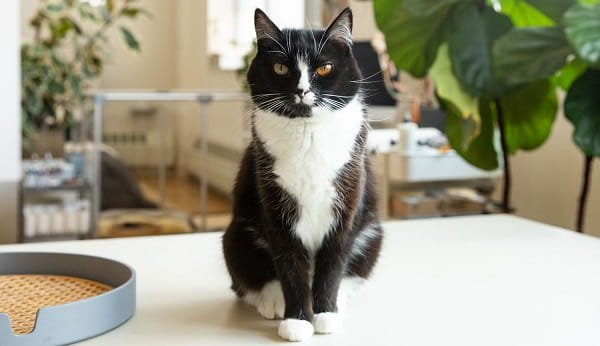
| Attribute | Details |
| Definition | Tuxedo = black coat with white on chest, belly, and typically paws — not a breed |
| Genetics | White spotting gene (S) — creates white patches on otherwise black coat |
| Both Genders | Unlike calico (almost always female), tuxedos occur in both male and female |
| Cultural Status | One of the most beloved and culturally recognised cat coat patterns globally |
| Famous Tuxedo Cats | Socks (White House cat), Sylvester (Looney Tunes), Felix the Cat, Mr. Mistoffelees (Cats musical) |
| Price Range India (2026) | Rs. 0 (adoption) – Rs. 1,10,000 (pedigreed show tuxedo) |
| Domestic Tuxedo | Free – Rs. 5,000 |
| Pedigreed Tuxedo (British Shorthair, Maine Coon) | Rs. 28,000 – Rs. 1,10,000 |
| Monthly Maintenance | Rs. 1,500 – Rs. 10,000 (breed-dependent) |
| India Availability | Very common in domestic cats — pedigreed tuxedo requires breeder sourcing |
About Tuxedo Cats
The tuxedo pattern results from the white spotting gene — specifically the KIT gene which controls the migration of pigment-producing cells (melanocytes) during embryonic development. When the white spotting gene is present in one copy (heterozygous), it creates partial white markings that typically concentrate on the underside, chest, and paws while leaving the back, head, and tail dark. The result — in a black cat with white spotting — is the classic tuxedo pattern that resembles formal evening dress.
The degree of white coverage varies from minimal (a small white chest patch and white toes only) to extensive (predominantly white with black restricted to the back and head) — creating a spectrum from “tuxedo” at the lower end to “bicolour” and ultimately “van pattern” at the extreme end. The classic tuxedo sits at approximately 30–50% white coverage, with the distribution concentrated on the chest, belly, chin, and paws.
Critically unlike the calico pattern, the tuxedo occurs in both male and female cats with equal frequency — because it depends on the white spotting gene rather than X-chromosome orange gene expression. This means male tuxedo cats are as common as female tuxedo cats, though both genders display the pattern with the same elegance and the same cultural associations.
The cultural history of the tuxedo cat is remarkably rich. Felix the Cat — the classic black-and-white cartoon cat created in 1919 — is the earliest and most globally recognisable tuxedo cat in popular culture, predating Mickey Mouse and establishing the tuxedo as the default animated cat appearance for decades. Sylvester from Looney Tunes continues this tradition. Socks, the tuxedo cat of President Bill Clinton’s White House (1993–2001), became one of the most famous American cats in presidential history. In T.S. Eliot’s “Old Possum’s Book of Practical Cats” (the source for Andrew Lloyd Webber’s “Cats”), the magical Mr. Mistoffelees is described as a black-and-white cat. This extraordinary cultural presence across art, politics, and entertainment reflects the tuxedo’s unique combination of formality and approachability that humans find endlessly compelling.
Tuxedo Cat Breeds Price in India 2026
| Tuxedo Cat Type | Min Price (INR) | Max Price (INR) |
| Indian Street Cat / Domestic Tuxedo — Adoption | Free | Rs. 2,000 |
| Domestic Tuxedo Shorthair | Rs. 1,000 | Rs. 5,000 |
| Tuxedo Persian | Rs. 12,000 | Rs. 60,000 |
| Tuxedo British Shorthair | Rs. 28,000 | Rs. 1,00,000 |
| Tuxedo Maine Coon | Rs. 40,000 | Rs. 1,10,000 |
| Tuxedo Exotic Shorthair | Rs. 22,000 | Rs. 80,000 |
| Tuxedo Norwegian Forest Cat | Rs. 45,000 | Rs. 1,10,000 |
| TICA / Show Quality Tuxedo Pedigreed | Rs. 55,000 | Rs. 1,10,000+ |
Famous Tuxedo Cats in History and Culture
No discussion of tuxedo cats is complete without acknowledging the remarkable cultural footprint these black-and-white cats have made across human history. Beyond Felix the Cat and Sylvester, the tuxedo pattern has appeared in the White House, in Nobel laureate households, and in scientific laboratories. Nora the tuxedo cat became a global internet celebrity in 2007 when her owner — a music teacher — shared videos of her voluntarily playing piano, accumulating millions of views and demonstrating the intelligence and curiosity that tuxedo cat owners often report.
Socks, President Clinton’s tuxedo cat, received more fan mail at the White House than the President himself during certain periods — a remarkable testament to the public affection the tuxedo pattern generates. The cat was so beloved that Hillary Clinton co-wrote a children’s book about him in 1994.
In India specifically, black-and-white cats including tuxedos carry mixed cultural associations — in some regional traditions they are considered auspicious, while in others black cats generally carry superstitious associations. The tuxedo’s white chest — associated with purity in Indian colour symbolism — generally tips the cultural balance toward positive interpretation in most Indian regional traditions.
Temperament Notes
Tuxedo pattern carries no specific temperament implications — personality is entirely determined by breed or individual heritage. However, several studies examining owner-reported personality assessments have found that owners of tuxedo cats tend to describe them as particularly playful, mischievous, and intelligent — whether this reflects genuine genetic correlation or the cultural narrative of the debonair, scheming tuxedo cat influencing perception is an open question in feline behaviour research.
Monthly Maintenance Cost in India (2026 Estimate)
| Tuxedo Cat Type | Monthly Cost Estimate |
| Domestic Tuxedo / Indian Indie | Rs. 1,500 – Rs. 3,500 |
| Tuxedo Persian | Rs. 4,000 – Rs. 9,000 |
| Tuxedo British Shorthair | Rs. 3,500 – Rs. 8,000 |
| Tuxedo Maine Coon | Rs. 4,500 – Rs. 10,000 |
Frequently Asked Questions (FAQs)
Q1. What is the tuxedo cat price in India in 2026?
A: Tuxedo cat prices depend entirely on breed. Domestic Indian tuxedo cats are available free through adoption or Rs. 1,000–Rs. 5,000. Tuxedo Persians range Rs. 12,000–Rs. 60,000. Tuxedo British Shorthairs Rs. 28,000–Rs. 1,00,000. Tuxedo Maine Coons Rs. 40,000–Rs. 1,10,000. TICA-registered show-quality tuxedo pedigreed cats start at Rs. 55,000.
Q2. What makes a tuxedo cat different from a bicolour cat?
A: Tuxedo and bicolour are related but distinct descriptions of white spotting patterns. Tuxedo typically refers specifically to black-and-white cats with approximately 30–50% white concentrated on the underside, chest, and paws — creating the formal-dress appearance. Bicolour is a broader term covering any two-colour cat with white. All tuxedo cats are technically bicolour, but not all bicolour cats are tuxedo — the term implies the specific formal-dress distribution of colour.
Q3. Are tuxedo cats more intelligent?
A: Multiple informal studies and extensive owner reports suggest tuxedo cats may be particularly playful and intelligent, but controlled scientific research has not conclusively established a correlation between coat colour and intelligence in domestic cats. The cultural narrative of the clever, mischievous tuxedo cat — reinforced by Felix, Sylvester, and other cultural representations — may influence owner perception and reporting.
Q4. Why is Felix the Cat a tuxedo?
A: Felix the Cat’s black-and-white design was created in 1919 by Pat Sullivan and Otto Messmer for the silent film era, when black-and-white contrast was the most visually effective design for early animation and film. The tuxedo pattern’s high contrast made Felix immediately readable on early film stock and in early animation. The pattern subsequently became so strongly associated with the cartoon cat aesthetic that it has persisted across a century of animation evolution.
Q5. Can I adopt a tuxedo cat in India?
A: Absolutely — tuxedo domestic cats are among the most commonly available coat patterns in Indian shelters. The high contrast of the black-and-white pattern makes tuxedo cats visually distinctive and often highlights their expression, making them among the most photogenic available. Every major Indian city’s shelters have tuxedo cats available for adoption at minimal or no cost.