India’s coastline extends over 7,500 kilometres — across the Arabian Sea to the west, the Bay of Bengal to the east, and the Indian Ocean to the south — offering an extraordinary range of beach environments. Goa’s beaches occupy a disproportionate share of the national conversation about Indian beach travel, and justifiably so for many purposes. But the most beautiful beaches in India are not necessarily the most famous ones. Beauty in the context of Indian beaches encompasses something more specific — the combination of water clarity, sand quality, geological distinctiveness, and the degree to which a beach retains its character without commercial overwriting.
1. Radhanagar Beach, Havelock Island, Andaman and Nicobar Islands
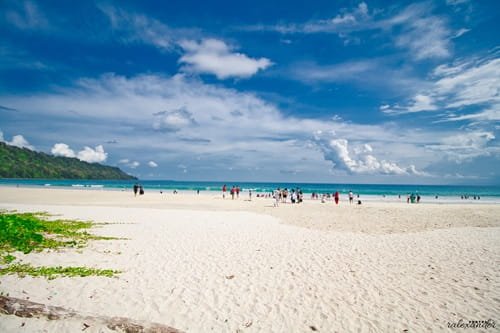
Time magazine once named Radhanagar Beach the best beach in Asia — and the claim is difficult to contest after experiencing it. The water is an improbable shade of turquoise that no photograph fully captures. The sand is the particular white that results from crushed coral over millennia. The forest comes directly to the beach’s edge — the transition from dense tropical vegetation to open sea is abrupt, dramatic, and entirely natural.
Havelock Island has accommodation that ranges from budget huts to mid-range resorts, but none of it is large-scale. The island’s limited infrastructure is genuinely conservation-driven — the absence of large hotels and the regulations around beach access after dark to protect sea turtle nesting preserve the beach’s quality in ways that more commercially developed destinations cannot.
How to Reach: Flight from Port Blair or ferry from Port Blair to Havelock Island. Best Season: November to April.
2. Om Beach, Gokarna, Karnataka
Karnataka’s Gokarna is the pilgrim town that also possesses what many coastal travellers consider India’s most beautifully shaped beach. Om Beach is named for its natural geography — seen from the clifftop approach, the two curved coves form the Sanskrit Om symbol. The approach to Om Beach — a 20-minute cliff path from Gokarna town that reveals the beach progressively as you descend — is itself one of India’s most dramatic beach approaches.
The water at Om Beach is clear enough for confident swimming, the rocks at the cove ends create sheltered natural pools, and the beach’s access difficulty — no road access, only the cliff path or boat — keeps it calmer than beaches with direct vehicle access. Basic beach shacks provide food and simple accommodation within walking distance.
How to Reach: Train to Gokarna Road station, then local transport to town, then walk to Om Beach. Best Season: October to March.
3. Varkala Beach, Kerala
The only beach in Kerala where cliffs come directly to the sea — Varkala’s dramatic laterite red cliffs create a completely distinctive visual character that separates it from every other Indian beach. The cliff-top path with its yoga centres, Ayurvedic massage rooms, café terraces, and sunset viewing spots overlooks a beach that is both swimmable and spiritually significant — the Papanasam Beach section is a Hindu pilgrimage point where ritual bathing takes place.
The coexistence of the sacred and the tourist at Varkala is genuinely interesting rather than uncomfortable — the beach holds both the Brahmin priest completing a ritual at the shoreline and the traveller reading a novel in a beach chair with complete natural ease.
How to Reach: Train from Thiruvananthapuram to Varkala station, then local transport to the cliff. Best Season: October to March.
4. Palolem Beach, Goa
Among Goa’s many beaches, Palolem in South Goa’s Canacona region earns its reputation for natural beauty through its geography rather than its infrastructure. A crescent of golden sand enclosed by forested headlands at both ends creates a protected bay that is calm enough for swimming, kayaking, and morning paddleboard yoga. The bay’s enclosed shape creates a theatre-like quality — watching the sun set over the headland from the water is one of Goa’s most beautiful beach experiences.
Palolem has developed significantly but has maintained a scale limit that keeps it from the overcrowding that affects North Goa’s beaches in season — the beach hut culture of the bamboo-and-cloth temporary structures gives Palolem a seasonal, impermanent quality that feels right for a beach destination.
How to Reach: Train to Canacona station, then taxi to Palolem. Best Season: November to February.
5. Chandipur Beach, Odisha
Odisha’s most genuinely unusual beach — the beach that disappears. The tidal range at Chandipur is among the highest in India — the sea recedes up to five kilometres at low tide, exposing a vast, flat expanse of wet sand, shallow tidal pools, and the occasional crab and horseshoe crab navigating the exposed seabed. At high tide, the sea returns to its normal position. Watching the sea disappear on foot — walking out into what was water hours earlier — is one of India’s most surreal natural experiences.
Chandipur is not a swimming beach or a sunbathing destination in the conventional sense. It is a tidal phenomenon that rewards the curious traveller who appreciates natural spectacle over recreational infrastructure.
How to Reach: Train to Balasore, then bus or taxi to Chandipur. Best Season: October to February.
Frequently Asked Questions (FAQs)
Q1. Are these beaches suitable for families with young children?
Palolem’s protected bay and Chandipur’s shallow tidal flat are the most suitable for families with young children. Radhanagar’s surf can be challenging for non-swimmers — the beach has designated safe swimming zones that families should observe. Varkala and Om Beach have significant currents that require swimming competence and adult supervision. Always verify current swimming conditions at any Indian beach before allowing children in the water.
Q2. What is the best time of year to visit the Andaman Islands for Radhanagar Beach?
November through April represents the best conditions — the northeast monsoon has cleared, sea conditions are calm, visibility for snorkelling and diving is at its peak, and the humidity is lower than the monsoon months. December and January are the most popular months for comfortable beach weather. The Andamans receive significant rainfall from May to October — beach visits during this period are possible but sea conditions are often unsuitable for swimming.
Q3. How do these beaches compare to popular Goa beaches in terms of crowd levels?
Radhanagar, Om Beach, and Chandipur are significantly less crowded than any major Goa beach in peak season. Varkala is busier than Om Beach but quieter than North Goa’s Baga or Calangute. Palolem is the busiest of the five during Goa’s December-January peak but remains calmer than Goa’s northern beaches. All five destinations provide genuinely less crowded beach experiences than India’s most commercially developed coastal locations.
Q4. Is it safe to swim at all these beaches?
Swimming safety varies by beach and season. Radhanagar Beach has designated swimming zones with lifeguard coverage during visiting hours. Palolem’s protected bay is consistently safe for confident swimmers. Om Beach has manageable currents in good weather conditions. Varkala’s cliff beach has stronger currents — check conditions before swimming. Chandipur is not a swimming beach — the tidal phenomenon makes conventional swimming impractical. Always check local conditions and follow lifeguard guidance.
Q5. What accommodation options are available near these beaches?
Havelock Island has a range from budget beach huts to mid-range resorts accessible in the Radhanagar Beach area. Om Beach has basic beach shack accommodation at accessible prices. Varkala’s cliff has developed a complete accommodation range from budget guesthouses to yoga retreat boutique hotels. Palolem’s beach hut culture provides seasonal accommodation directly on the beach. Chandipur has government-run tourism accommodation in Balasore and basic lodges near the beach. None of these destinations has large-scale hotel development — which is precisely what preserves their character.