Budgerigars — universally known as budgies — hold a unique position in the Indian pet bird market that no other species comes close to matching. They are simultaneously the most affordable, the most widely available, the most beginner-friendly, and among the most genuinely rewarding pet birds a person can own. Despite their small size and modest price tags, budgies are intelligent, social, communicative birds that form real bonds with their human companions — and a well-cared-for budgie in the right environment will fill a home with colour, movement, and cheerful noise that belies how little they cost to acquire and maintain.
Legal Status of Budgies in India
Budgerigars (Melopsittacus undulatus) are native to Australia, not India — which means they fall outside the prohibitions of the Wildlife Protection Act of 1972 that restrict native Indian bird species. Captive-bred budgies can be legally owned, traded, and bred in India without CITES documentation requirements, since they are domestically bred over many generations and are not subject to international wild bird trade regulations. This makes them one of the legally simplest exotic bird options available to Indian pet owners.
Factors That Determine Budgie Prices
The budgie market in India spans an enormous price range — from as little as ₹300 for a common green budgie at a local market, to ₹8,000 or more for a show-quality English Budgerigar with champion lineage. Understanding what drives this range helps buyers make better decisions.
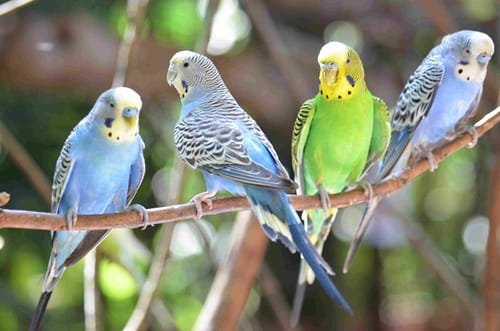
Variety and colour mutation is the primary driver. Standard green and yellow budgies — the wild-type colouration — are produced in enormous numbers and sold at the lowest prices. Colour mutations including blue, white, violet, grey, pied, opaline, spangle, and clearwing varieties each command higher prices proportional to their rarity and visual appeal in the current market.
English Budgies versus Australian/Indian Budgies represent a significant price distinction. English Budgerigars — bred for show standards — are considerably larger than their common counterparts, with fuller face feathering, a distinctly rounded head profile, and calmer, more placid temperaments. These birds cost significantly more than standard budgies and are sought after by serious enthusiasts and show bird breeders.
Age and taming status matter — as with any parrot species, hand-raised, hand-fed fledglings that are already comfortable with human contact command a premium over parent-raised birds that require patient socialisation work.
Price Range by Variety
Common green/yellow budgie: ₹300 – ₹800. Widely available at local bird markets and pet shops across India.
Standard colour mutations (blue, white, violet, grey): ₹600 – ₹2,000. Available in most cities with active bird markets.
Rare mutations (spangle, clearwing, pied combinations): ₹1,500 – ₹4,000. Available from specialist breeders.
English Budgerigar (standard): ₹2,000 – ₹5,000. Larger birds from established English Budgie breeders.
English Budgerigar (show quality / champion lineage): ₹4,000 – ₹10,000+. Top-quality specimens from competitive show breeding lines.
Setup and Ongoing Care Costs
The accessibility of budgies extends well beyond their purchase price — they are among the least expensive pet birds to properly maintain in India. A suitable cage runs ₹1,500 to ₹6,000. Monthly food costs — quality seed mix, pellets, fresh greens, cuttlebone — typically come to ₹300 to ₹800. Annual veterinary costs for a healthy budgie average ₹2,000 to ₹6,000. Toys and enrichment add ₹300 to ₹800 monthly. Total annual ownership costs for a properly maintained budgie typically run ₹8,000 to ₹20,000 — making them genuinely accessible for a wide range of Indian households.
Important Ownership Considerations
Budgies are flock birds by nature and are almost always happiest in pairs or small groups. A single budgie kept in isolation without significant daily human interaction is a budgie under chronic low-grade stress. If you cannot commit to spending multiple hours daily actively engaging with a single bird, buying a pair is not just a convenience — it is genuinely better for the birds’ welfare.
Budgies are more fragile than their robust personalities suggest. Drafts, smoke, non-stick cookware fumes (PTFE/Teflon), scented candles, and aerosol sprays can all be fatal. Kitchen placement is particularly dangerous. Their respiratory systems are extraordinarily sensitive to airborne toxins that humans tolerate without issue.
With regular gentle handling from a young age, budgies become remarkably tame and interactive. Males in particular are natural vocalists — some develop impressive mimicry of words and phrases, though with softer, chattier voices than larger parrots. A tame budgie that rides on your shoulder, responds to its name, and chatters throughout the day is one of the most delightful, low-maintenance companions available in the Indian pet bird market.