India’s street food culture is one of the most vibrant, diverse, and genuinely delicious in the world. Every city, every region, and sometimes every neighbourhood has its own version of something extraordinary — cooked on a tawa by someone who has been perfecting the same recipe for twenty years, served on a leaf plate or in a paper cone, eaten standing at a cart while the world moves around you. Street food in India isn’t a lesser version of restaurant food. It is often the best version of food — uncompromised by commercial kitchen scaling, made by someone whose reputation in a half-kilometre radius depends entirely on how their one dish tastes today.
1. Pani Puri (Golgappa / Puchka)
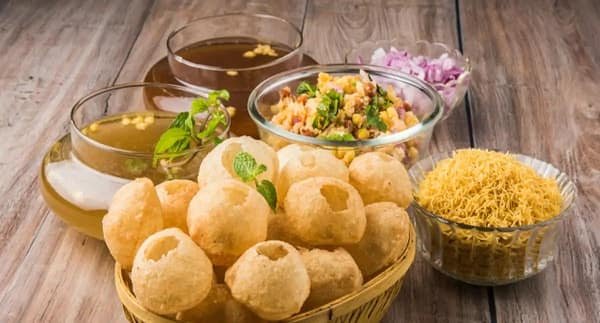
India’s most beloved street food goes by different names across different regions — Golgappa in Delhi and the North, Puchka in Kolkata, Pani Puri across Maharashtra and Gujarat — but the experience is universally transcendent. A hollow, crispy puri filled with spiced potatoes or sprouted moong, dunked in tangy tamarind water or spiced jeera water, and consumed in a single explosive bite. The combination of textures and the contrast of temperatures and flavours happens simultaneously in a single mouthful — there is nothing else quite like it in global cuisine.
2. Vada Pav
Mumbai’s unofficial official food. A deep-fried spiced potato vada tucked inside a soft pav bun, accompanied by dry garlic chutney and green chilli chutney. What sounds simple is devastatingly good — the crispy exterior of the vada, the softness of the pav, the heat of the chutney, and the satisfaction of something entirely complete at ₹15 to ₹30. Mumbai’s relationship with Vada Pav is genuinely emotional — locals judge the city’s new food trends by whether they can compete with the best Vada Pav stall in their neighbourhood.
3. Chole Bhature
Delhi’s morning glory — the combination of spiced chickpeas in a rich, tangy gravy alongside pillowy, deep-fried bhature that puff magnificently in hot oil. Chole Bhature is technically a breakfast food in Delhi but is consumed enthusiastically at all hours. The chole must have depth and complexity — developed over hours of slow cooking with whole spices. The bhature must be perfectly light inside despite the frying. When both elements are right, it is one of the most satisfying single-dish meals in Indian cooking.
4. Kachori and Sabzi
Rajasthan and Uttar Pradesh’s contribution to the Indian street food canon — a thick, crispy, deep-fried kachori filled with spiced dal or onion mixture, served with potato sabzi and a splash of tamarind chutney. Jodhpur’s Pyaaz Kachori and Varanasi’s Dal Kachori are the most celebrated regional variations, each with local loyalists who will debate their superiority with genuine passion.
5. Dosa with Sambar and Chutney
The South Indian dosa has transcended its regional origins to become one of India’s most universally loved street foods — available from Chennai beach stalls, Mumbai fast food counters, and Delhi market carts. The crispness of the fermented rice and lentil crepe, the aromatic potato filling of a masala dosa, and the combination with coconut chutney and sambar create a complete meal at street food prices.
6. Aloo Tikki
Delhi’s answer to the burger — spiced mashed potato patties fried until golden and crispy, served with yoghurt, tamarind chutney, coriander chutney, and chaat masala. Aloo Tikki by itself is a complete chaat experience. Aloo Tikki Burger — the tikki served inside a bun — has become a legitimate fast food category across North India.
7. Bhelpuri
Mumbai’s defining chaat — puffed rice, sev, boiled potatoes, raw onion, and tomato tossed with tamarind and green chutney in a paper cone that you eat immediately before the textures change. Bhelpuri must be assembled and eaten within minutes — it is one of the few Indian street foods where freshness is measured in seconds rather than hours. Juhu Beach’s Bhelpuri stalls are among the most democratically attended food spaces in India.
8. Keema Pav
Mumbai and Pune’s carnivore street food icon — slow-cooked minced mutton or chicken in a deeply spiced masala, served with buttered pav and raw onion. Keema Pav is the meat-eater’s answer to Vada Pav and is cooked in its best versions by Irani cafe owners and Muslim quarter cooks who have spent decades developing their masala complexity.
9. Momos
Northeast India’s contribution to the national street food vocabulary — steamed or fried dumplings filled with vegetables, chicken, or mutton, served with a fiery red chutney. Momos have moved from Tibetan refugee communities in Dharamsala to become one of the most popular street foods across Indian cities. Delhi’s Majnu Ka Tilla momos and Darjeeling’s steamed chicken momos are the most celebrated regional versions.
10. Pav Bhaji
The collective bhaji — a heavily spiced, buttery mash of mixed vegetables served with pav that is toasted on a griddle slicked with generous amounts of butter. Born from Mumbai’s textile mill workers’ need for a quick, filling, affordable meal, Pav Bhaji has become a national comfort food whose best versions are made on enormous cast iron tavas that have absorbed decades of spice and butter.
Frequently Asked Questions (FAQs)
Q1. Which Indian city has the most diverse street food scene?
A: Mumbai and Delhi are the two strongest arguments, reflecting their respective positions as cultural melting pots that absorb and transform food from across India. Mumbai’s street food is defined by the Vada Pav, Bhelpuri, and Pav Bhaji tradition. Delhi’s street food reflects North Indian Mughal and Punjabi influence through Chole Bhature, Aloo Tikki, and kebab culture. Kolkata makes an equally strong case with its Puchka, Kathi rolls, and jhal muri tradition. The honest answer is that every Indian city has a distinctive street food identity worth exploring independently.
Q2. Is Indian street food safe to eat for first-time visitors?
A: The safety of Indian street food correlates with a few observable factors rather than a blanket assessment. High turnover stalls — where food is cooked continuously and never sits — carry lower risk than stalls with food sitting out. Stalls that cook everything to order in front of you carry lower risk than those serving pre-prepared items. Your own digestive acclimatisation matters — gradual introduction rather than maximum variety on the first visit reduces adjustment difficulty.
Q3. Are there vegetarian options across all these street foods?
A: Yes — the overwhelming majority of India’s street food canon is vegetarian by tradition. Pani Puri, Vada Pav, Bhelpuri, Aloo Tikki, Chole Bhature, Kachori, Dosa, and Pav Bhaji are all entirely vegetarian. Momos are available in both vegetarian and non-vegetarian versions at virtually every stall. Keema Pav is the one predominantly non-vegetarian item on this list, though vegetarian versions using soya keema are increasingly available.
Q4. Which street food is most uniquely Indian and least replicable elsewhere?
A: Pani Puri is arguably the most uniquely Indian street food experience — the combination of technique, texture contrast, flavour balance, and the specific cultural ritual of eating it standing at a cart while the vendor fills each puri individually creates an experience that restaurant versions, international food courts, and home preparation all genuinely fail to replicate. The pani puri cart experience is specifically, irreducibly Indian.
Q5. Can these street foods be made at home to a comparable standard?
A: Most can be approximated at home with varying degrees of success. Pav Bhaji, Chole Bhature, and Aloo Tikki are among the most successfully home-replicable because the cooking method is relatively straightforward and the ingredients are universally available. Pani Puri requires making hollow puris that puff correctly — a technique that rewards practice. Bhelpuri assembled at home works well when the chutneys are genuinely good. Vada Pav’s success depends heavily on the chutney quality — the dry garlic chutney is the element that most home versions underprepare.