India’s most famous hill stations — Shimla, Manali, Mussoorie, Ooty, and Darjeeling — have been loved into something approaching saturation during peak season. The infrastructure that developed around their popularity has transformed these towns into experiences that are genuinely enjoyable but rarely tranquil. The hill station experience that most people seek — the clean air, the unhurried pace, the sense of genuine escape from urban density — is more reliably found in the towns that didn’t make the major tourism circuits. These hidden hill stations offer the mountains without the crowds, the colonial architecture without the souvenir shops, and the forest walks without the traffic jams.
Munsiyari, Uttarakhand
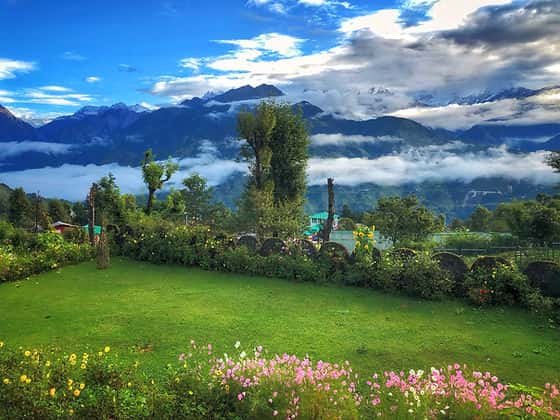
Sitting at 2,200 metres in Kumaon’s Johar Valley, Munsiyari is the last significant town before the Indo-Tibet border — a position that kept it genuinely remote until improved road connectivity made it accessible to the determined traveller. The Panchauli Peaks — five snow-capped summits that turn pink and orange at sunrise and gold at sunset — are visible from the town in a panoramic sweep that ranks among the most spectacular Himalayan views accessible without serious trekking.
Munsiyari is the base for the Milam Glacier trek, the Khaliya Top rhododendron forests, and the Birthi Falls accessible 35 kilometres below the town. Accommodation is basic but clean — homestays that feed guests extraordinary Kumaoni food alongside the mountain views. The town has no mall road, no organised amusement, and no evening light show — precisely the characteristics that make it extraordinary.
Best Season: April to June and September to November.
Khajjiar, Himachal Pradesh
Called India’s Switzerland by the Himachal Pradesh government — and the comparison has enough visual merit that it doesn’t feel entirely hyperbolic. A circular meadow at 2,000 metres, ringed by dense deodar cedar forests, with a glacial lake at its centre and snow-capped peaks visible on clear days. Khajjiar sits 22 kilometres from Dalhousie — close enough to use Dalhousie’s better accommodation infrastructure while spending the day in Khajjiar’s extraordinary natural setting.
The Khajjiar meadow is ideal for simply being — the activity is sitting in the grass, watching clouds move across the deodar canopy, and experiencing the specific stillness of a mountain meadow in the late afternoon light.
Best Season: March to June and September to November.
Kodaikanal, Tamil Nadu
Tamil Nadu’s hill station is familiar by name but less crowded in practice than its Nilgiris neighbour Ooty — particularly outside the summer months when domestic tourism peaks. The Palani Hills at 2,000 metres offer a consistently cooler microclimate than any Tamil Nadu plains city. Kodaikanal Lake is the town’s centrepiece — a star-shaped reservoir ringed by a cycling and walking path through shola forests.
Pillar Rocks, Coaker’s Walk, and the Berijam Lake — accessible only with forest department permission — reward visitors who explore beyond the lake’s immediate surroundings. The town’s chocolate and homemade cheese cottage industries produce genuinely excellent products.
Best Season: September to May. Avoid the core summer season when domestic visitor volumes peak.
Tawang, Arunachal Pradesh
One of India’s most extraordinary but least-visited destinations — a high-altitude Buddhist town at 3,000 metres in Arunachal Pradesh’s far western corner, home to the Tawang Monastery, the largest monastery in India. The road from Dirang through the Se La Pass at 4,170 metres is one of India’s most spectacular mountain drives — the pass is frequently snowbound even in April, creating the sense of crossing into a genuinely different world.
The Tawang Monastery’s golden roofs against the blue sky, the Sela Lake’s stillness at altitude, and the town’s cultural proximity to Tibetan Buddhist tradition create an experience that has no equivalent elsewhere in India.
Best Season: March to October. Winter access is restricted by snow.
Chikmagalur, Karnataka
The coffee country of Karnataka’s Malnad region — rolling hills covered with coffee and spice plantations at 900 to 1,900 metres, with the Mullayanagiri Peak providing the highest accessible summit in Karnataka. Chikmagalur is a destination where the experience is plantation walks at dawn in the mist, homemade filter coffee prepared by estate owners, and the specific silence of a landscape where commercial tourism hasn’t yet overwritten the agricultural reality.
Homestays on working coffee estates are the ideal accommodation — the experience of waking before sunrise to walk through flowering coffee with a cup of something extraordinary is one of India’s most underrated travel pleasures.
Best Season: September to February.
Frequently Asked Questions (FAQs)
Q1. How do I reach these less-connected hill stations without a private vehicle?
Munsiyari and Tawang have shared jeep services from their respective district headquarters — Almora for Munsiyari and Tezpur for Tawang — that carry passengers regularly. Chikmagalur is accessible by bus from Bengaluru and Hassan. Khajjiar is reached by local bus or taxi from Dalhousie which has bus connectivity to Pathankot. Private vehicles or rental cars from the nearest railway station provide the most flexible access for all these destinations.
Q2. Are these destinations suitable for elderly travellers?
Khajjiar and Kodaikanal are the most accessible for older travellers — flat meadow walking and well-developed infrastructure support comfortable visits at any age. Munsiyari and Chikmagalur require moderate mobility for their most rewarding experiences — plantation and forest walks. Tawang’s high altitude demands adequate acclimatisation regardless of age — altitude sickness awareness is essential for all visitors.
Q3. What permits are required for these destinations?
Tawang requires an Inner Line Permit for Indian citizens from outside Arunachal Pradesh — obtained online through the Arunachal Pradesh government portal. Munsiyari has no special permit requirement for Indian citizens. Kodaikanal’s Berijam Lake visit requires a forest department permit available at the lake’s entry point. Other destinations have no special permit requirements.
Q4. How do these hidden hill stations compare in cost to the popular ones?
All of these destinations offer significantly lower accommodation, food, and activity costs than comparable popular hill stations. Manali’s peak season rates are three to five times higher than Munsiyari’s for equivalent comfort levels. The absence of commercial tourism infrastructure at these destinations keeps costs genuinely accessible while the experience is often superior.
Q5. Which hidden hill station is best for a first-time visitor looking for something different from the mainstream circuit?
Chikmagalur is the most accessible introduction to India’s hidden hill station circuit — well-connected from Bengaluru, comfortable accommodation options, a clear activity structure around plantation walks and peak trekking, and a food culture anchored in the region’s agricultural produce. It provides the sense of discovery without the logistical challenge of the more remote options.