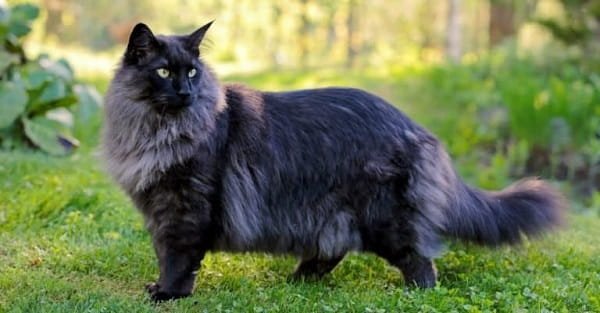
The Norwegian Forest Cat — known in its native Norway as the “Norsk Skogkatt” (literally “Norwegian Forest Cat”) — is one of the most majestic, naturally developed, and historically significant cat breeds in the world. A large, heavily built semi-longhaired cat with a water-resistant double coat that evolved over centuries in the cold, wet forests of Scandinavia, the Norwegian Forest Cat carries an air of wild Nordic grandeur that makes it one of the most striking feline presences available in India’s growing premium cat market.
In Norse mythology, the Skogkatt holds a specific and honoured place — the goddess Freya’s chariot was said to be pulled by two large cats described in the Eddic poems as being too large and too powerful for the other gods to lift. These mythological cats are widely believed by Norwegian folklore scholars to have been Norwegian Forest Cats — a connection that has made the breed a matter of national pride in Norway comparable to the Swiss connection with the Saint Bernard. In India in 2026, the Norwegian Forest Cat is rare, premium, and genuinely extraordinary — this guide provides accurate pricing, complete breed information, and everything needed to make a responsible purchase decision.
| Attribute | Details |
| Breed Name | Norwegian Forest Cat (Norsk Skogkatt / Wegie) |
| Origin | Norway — natural breed developed over centuries in Scandinavian forests |
| Norse Mythology | Freya’s chariot cats — widely identified as Norwegian Forest Cats |
| Size | Large: 4–9 kg — slow maturing, reaches full size at 5 years |
| Lifespan | 14–16 years |
| Temperament | Gentle, independent, playful, affectionate on own terms, athletic, curious |
| Coat | Semi-long, water-resistant double coat — dense undercoat plus glossy outer coat |
| Triangular Head | Distinctive equilateral triangle head shape — breed standard feature |
| Price Range (2026) | Rs. 40,000 – Rs. 1,30,000 |
| TICA / FIFe Show Quality | Rs. 80,000 – Rs. 1,30,000+ |
| Monthly Maintenance | Rs. 4,500 – Rs. 10,000 |
| Best For | Active experienced cat owners, large apartments or houses, nature enthusiasts |
| Climate Note | Dense double coat requires significant grooming management in Indian summers |
About the Norwegian Forest Cat
The Norwegian Forest Cat’s origin in Scandinavia is measured not in decades but in centuries — DNA analysis confirms the breed as one of the oldest European domestic cat types, closely related to other Nordic breeds but genetically distinct from Mediterranean and Middle Eastern cat populations. Norwegian folk tales and legends reference large, fluffy forest cats with climbing ability and wild independence — the “huldrekat” (spirit cat of the forest) and similar folkloric creatures that match the Skogkatt’s description appear in Norwegian rural tradition from the Middle Ages onward.
The breed’s most famous mythological connection — Freya’s chariot cats — appears in the Prose Edda compiled by Snorri Sturluson in the 13th century. Freya, the Norse goddess of love, beauty, and fertility, travels in a chariot drawn by two grey cats. When the trickster god Loki challenged the strength of these cats and attempted to lift one, he could not — a story that emphasises the extraordinary power and independence of these mythological felines. Norwegian folklore scholars and cat historians widely accept that these mythological cats were inspired by the large, powerful Skogkatt that Norwegian farmers and fishermen would have encountered daily.
The breed was nearly lost to extinction in the early 20th century as domestic cats crossbred widely and the pure Skogkatt type became diluted. A dedicated preservation effort began in Norway in the 1930s when King Olav V designated the Norwegian Forest Cat as Norway’s official national cat. A formal breed club was established, and by the 1970s the Norsk Skogkattring (Norwegian Forest Cat Club) had established studbooks and breed standards that formed the basis for international recognition. The breed reached TICA championship status and has grown into one of the world’s most popular pedigreed breeds — consistently ranking in the top five in European cat registrations.
In India, Norwegian Forest Cats began appearing from approximately 2019 onward through specialist importers. By 2024–2025, a very small number of Indian breeders have established programs with imported foundation stock, making the breed more accessible than it was but still genuinely rare.
Norwegian Forest Cat Price in India 2026 — City-Wise Breakdown
| City / Category | Min Price (INR) | Max Price (INR) |
| Delhi / NCR | Rs. 45,000 | Rs. 1,10,000 |
| Mumbai | Rs. 48,000 | Rs. 1,20,000 |
| Bangalore | Rs. 40,000 | Rs. 1,00,000 |
| Hyderabad | Rs. 38,000 | Rs. 95,000 |
| Chennai | Rs. 35,000 | Rs. 88,000 |
| Kolkata | Rs. 32,000 | Rs. 85,000 |
| Tier-2 / Tier-3 Cities | Rs. 25,000 | Rs. 65,000 |
| TICA / FIFe Registered Show Quality | Rs. 80,000 | Rs. 1,30,000+ |
| Imported — Norway / Scandinavia / Europe | Rs. 1,00,000 | Rs. 1,70,000+ |
Norwegian Forest Cat vs Maine Coon — The Common Confusion
The Norwegian Forest Cat and the Maine Coon are frequently confused by Indian buyers — both are large, semi-longhaired, tufted-ear breeds with wild-cat appearance. The key distinctions help buyers identify which breed they are actually purchasing. The Norwegian Forest Cat has a distinctly triangular head — an equilateral triangle shape that is a breed standard requirement. The Maine Coon has a longer, more rectangular head. The Norwegian Forest Cat’s hind legs are longer than its front legs, creating a characteristic sloping profile when standing. The Maine Coon’s body is more rectangular. The Norwegian Forest Cat’s coat is slightly harder-textured and more water-resistant. DNA testing definitively distinguishes them — and TICA or FIFe registration papers confirm breed identity. Sellers should be able to clearly document which breed they are offering.
Temperament and Suitability
The Norwegian Forest Cat’s temperament reflects its centuries of independent forest living — it is more self-sufficient and less people-dependent than the Ragdoll or Burmese, while being genuinely affectionate and social on its own terms. It does not demand constant attention but enjoys human company and will seek interaction when it chooses. It maintains the wild cat’s curiosity and athletic confidence — climbing to the highest available point in any room, exploring every new object with methodical investigation, and displaying an outdoor cat’s alertness and quick reflexes even as an indoor companion.
They are playful and maintain their athleticism throughout their long lives. Puzzle toys, cat trees with substantial height, and interactive wand toys provide the mental and physical stimulation this active breed needs. They are generally good with children and other cats, adaptable to multi-pet households, and manageable for experienced cat owners who appreciate independent feline personalities.
Health and Lifespan
The Norwegian Forest Cat is generally a healthy, robust breed with a 14–16 year lifespan. Hypertrophic Cardiomyopathy (HCM) is the primary hereditary concern — annual echocardiographic screening of breeding cats is essential. Glycogen Storage Disease Type IV (GSD IV) is a serious metabolic disease documented in Norwegian Forest Cats — a DNA test exists and responsible breeders must provide clear certificates for both parents. Hip Dysplasia occurs in the breed — OFA screening of breeding cats is recommended.
The double coat in India’s climate requires serious management attention. The dense undercoat can felt severely in India’s humidity during monsoon season without regular brushing. Professional grooming every 6–8 weeks with thorough high-velocity drying after bathing is essential. Many Indian Norwegian Forest Cat owners adopt a summer body trim — maintaining the characteristic head and tail coat while shortening the body coat during April–August for improved comfort and grooming management.
Monthly Maintenance Cost in India (2026 Estimate)
| Cost Category | Estimated Cost |
| Premium High-Protein Cat Food | Rs. 2,000 – Rs. 5,000/month |
| Professional Grooming (dense double coat) | Rs. 1,500 – Rs. 3,200/session; every 6–8 weeks |
| Litter and Litter Box | Rs. 500 – Rs. 1,500/month |
| Veterinary Care (annual incl. HCM + GSD IV) | Rs. 7,000 – Rs. 18,000 |
| Vaccinations & Preventives | Rs. 2,000 – Rs. 4,500 annually |
| Total Estimated Monthly Cost | Rs. 4,500 – Rs. 10,000 |
Conclusion
The Norwegian Forest Cat — Freya’s mythological chariot companion, Norway’s national cat pride, and one of nature’s finest semi-longhaired achievements — brings to India’s 2026 premium cat market an extraordinary combination of wild Nordic beauty, gentle independent personality, and the kind of deep genetic robustness that centuries of natural forest selection produce. For experienced Indian cat enthusiasts who want a large, magnificently coated cat with genuine wild-forest presence and are prepared for the grooming commitment India’s climate demands, the Norwegian Forest Cat offers one of the most genuinely distinctive and deeply rewarding feline ownership experiences available anywhere in the world.
Frequently Asked Questions (FAQs)
Q1. What is the Norwegian Forest Cat price in India in 2026?
A: Norwegian Forest Cat prices from reputable sources in India in 2026 range from Rs. 32,000 to Rs. 1,20,000 depending on city, colour, and documentation. TICA or FIFe-registered show-quality cats start at Rs. 80,000. Norwegian, Scandinavian, or European imports reach Rs. 1,00,000–Rs. 1,70,000+ including import costs.
Q2. Are Norwegian Forest Cats really in Norse mythology?
A: Yes — the Eddic poems compiled in the 13th century describe the goddess Freya’s chariot being pulled by two large, powerful cats that even the gods could not lift. Norwegian folklore historians and cat breed scholars widely accept these mythological cats as being inspired by the Norsk Skogkatt — the large, powerful, and genuinely athletic Norwegian Forest Cat that Norwegian farmers and fishermen would have been familiar with. This mythological connection is part of the breed’s national heritage in Norway.
Q3. What is Glycogen Storage Disease IV and why does it matter?
A: GSD IV is a severe metabolic disease causing glycogen accumulation in organs and muscles — it is fatal in affected kittens. A DNA test exists that identifies cats as Clear, Carrier, or Affected. Responsible breeders test all breeding cats and pair only Clear-to-Clear or Clear-to-Carrier to ensure no Affected kittens are produced. This is the most breed-specific hereditary concern in Norwegian Forest Cats. Always request GSD IV DNA test certificates for both parents before purchasing.
Q4. How do I tell a Norwegian Forest Cat from a Maine Coon?
A: Key distinguishing features: the Norwegian Forest Cat has a distinctly equilateral triangular head shape; the Maine Coon has a longer rectangular head. The Norwegian’s hind legs are longer than its front legs creating a sloping back profile; the Maine Coon is more level. The Norwegian’s coat has a harder, more water-resistant outer coat texture. DNA testing definitively distinguishes them, and TICA or FIFe registration papers provide the most reliable breed confirmation.
Q5. How do I manage a Norwegian Forest Cat’s coat in India’s monsoon?
A: Monsoon season (July–September) is the most challenging period for Norwegian Forest Cat coats in India. The combination of high humidity and the dense double coat creates rapid mat formation if brushing is reduced. Increase professional grooming frequency to every 4–5 weeks during July–September. Brush at home every 2–3 days during this period. Ensure complete coat drying after any bathing or rain exposure. Many Indian owners find a body trim (maintaining head, neck mane, and tail coat while shortening the body) to be the most practical monsoon management approach.