The Ragdoll is one of the most beloved large cat breeds in the world — a strikingly beautiful, blue-eyed, semi-longhaired cat that combines the visual impact of a Persian with a temperament so gentle and relaxed that it earned its name from the tendency of early individuals to go completely limp when picked up, like a child’s ragdoll toy. Developed in California in the 1960s by breeder Ann Baker, the Ragdoll has grown from a small, carefully controlled breeding program into one of the world’s most popular pedigreed cat breeds, consistently ranking in the top three globally by registration numbers.
In India’s growing premium cat market of 2026, the Ragdoll has established itself as one of the most sought-after breeds — appealing particularly to buyers who want a large, visually spectacular cat with an exceptionally gentle, apartment-friendly temperament. Its combination of large size, stunning blue eyes, and a personality described by owners as more dog-like than cat-like makes it a particularly compelling choice for Indian urban households. This guide covers current 2026 pricing across all major Indian cities, the important colour and pattern varieties, health realities, grooming requirements, and everything a responsible buyer needs to know before bringing a Ragdoll home.
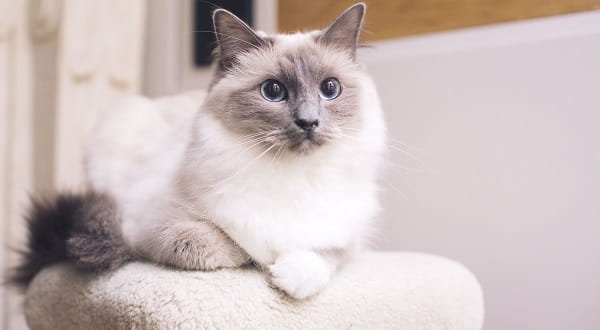
| Attribute | Details |
| Breed Name | Ragdoll |
| Origin | Riverside, California, USA — developed by Ann Baker from 1963 |
| Size | Large: 4.5–9 kg — one of the largest domestic cat breeds |
| Lifespan | 12–17 years |
| Temperament | Gentle, calm, affectionate, dog-like, sociable, low-aggression |
| Coat | Semi-long, silky, low-mat tendency — colourpoint, mitted, or bicolour |
| Eye Colour | Always blue — a defining breed characteristic |
| Price Range (2026) | Rs. 30,000 – Rs. 1,50,000+ |
| TICA / CFA Show Quality | Rs. 80,000 – Rs. 1,50,000+ |
| Monthly Maintenance | Rs. 4,000 – Rs. 10,000 |
| Best For | Families, apartment dwellers, first-time cat owners, dog lovers |
| Climate Note | Semi-long coat needs management in Indian summers — AC recommended |
| Health Priority | HCM cardiac screening of parents — essential before purchase |
About the Ragdoll
The Ragdoll’s origin story is one of the most colourful in cat breeding history. Ann Baker, a Persian cat breeder in Riverside, California, began developing the breed in the early 1960s using a white domestic longhaired cat named Josephine as her foundation. Josephine, who had been injured in a road accident, subsequently produced kittens with an unusually gentle, relaxed temperament — and Baker selectively bred for this characteristic across subsequent generations, eventually creating a consistent breed type with the Ragdoll’s defining characteristics: large size, blue eyes, pointed colouration, and the famous tendency to relax completely when handled.
Baker’s breeding program was famously secretive and unconventional — she patented the Ragdoll name, established franchise breeding arrangements, and made extraordinary claims about the breed’s origins. After her death, the Ragdoll was formally accepted by TICA in 1993 and by the CFA in 2000, and has since grown into one of the world’s most registered pedigreed cat breeds. In India, Ragdolls began appearing from approximately 2015 onward and have seen consistent growth in interest through 2024–2025, with established breeders in Delhi, Mumbai, and Bangalore now producing TICA-registered litters domestically.
The Ragdoll’s most distinctive characteristic beyond its appearance is its temperament — described by virtually every owner and breed authority in almost identical terms: calm, gentle, trusting, affectionate, and dog-like in its social engagement. Ragdolls follow their owners through the home, greet them at the door, enjoy being carried and handled, and adapt to the rhythms of their household with a flexibility that makes them outstanding apartment companions. They are not independent aloof cats in the classic feline tradition — they are genuinely social animals that seek human company and express their affection openly.
Ragdoll Price in India 2026 — City-Wise Breakdown
| City / Category | Min Price (INR) | Max Price (INR) |
| Delhi / NCR | Rs. 35,000 | Rs. 1,10,000 |
| Mumbai | Rs. 38,000 | Rs. 1,20,000 |
| Bangalore | Rs. 30,000 | Rs. 1,00,000 |
| Hyderabad | Rs. 28,000 | Rs. 95,000 |
| Chennai | Rs. 25,000 | Rs. 88,000 |
| Kolkata | Rs. 24,000 | Rs. 85,000 |
| Chandigarh / Jaipur | Rs. 28,000 | Rs. 92,000 |
| Tier-2 / Tier-3 Cities | Rs. 18,000 | Rs. 60,000 |
| TICA / CFA Registered / Show Quality | Rs. 80,000 | Rs. 1,50,000+ |
| Imported — USA / Europe | Rs. 1,00,000 | Rs. 1,80,000+ |
Note: The lower price range in India often reflects cats without documented TICA or CFA pedigree — these may be genuine Ragdolls from undocumented breeding programs or Ragdoll-type domestic cats. Genuine, documented Ragdolls from TICA-registered parents with HCM cardiac screening typically start at Rs. 55,000–Rs. 60,000 in metro cities. Always request both TICA registration papers and HCM cardiac screening results for both parent cats before purchase.
Colour and Pattern Varieties
The Ragdoll comes in a specific range of colours and three distinct pattern types that every buyer should understand. The six accepted colours are seal, blue, chocolate, lilac, red, and cream — with seal and blue being by far the most commonly available in India.
The three pattern types create significantly different visual appearances within each colour. Colourpoint Ragdolls have darker colouration on the face mask, ears, legs, and tail against a lighter body — similar to the Siamese colour distribution. This is the classic Ragdoll pattern and the most widely available in India. Mitted Ragdolls have the colourpoint pattern with the addition of white mittens on the front paws, white boots on the back legs, and a white chin — a particularly charming variation. Bicolour Ragdolls have a distinctive inverted V-shaped white blaze on the face, white legs, and a white belly — the most dramatic and arguably most visually striking of the three patterns, commanding slight premiums.
Seal point — dark brown-black points with a pale cream body — is the most iconic and most available. Blue point — steel grey points with a cold white body — is the second most popular. Chocolate, lilac, red, and cream are rarer in India and command premiums of 20–40% over seal and blue.
Temperament and Suitability
The Ragdoll’s temperament is the primary reason for its global popularity and it is every bit as exceptional as its reputation suggests. These cats are genuinely among the most calm, gentle, and human-oriented cat breeds in existence. Their low aggression threshold — they rarely scratch or bite even when handled roughly — combined with their social affection makes them particularly suitable for households with children and multiple pets.
They are indoor-only cats by nature and design — their trusting, non-defensive temperament makes them vulnerable in outdoor environments where the normal feline wariness and territorial instinct provides protection. For Indian apartment living, this indoor orientation is a practical advantage — Ragdolls are entirely content within a well-enriched apartment environment provided they have human company and appropriate enrichment.
Their dog-like qualities are genuine — many Ragdolls learn to play fetch, walk on a harness and leash, and respond consistently to their name. They follow their owners from room to room, enjoy being carried over the shoulder or cradled on their back (the ragdoll flop), and are unusually tolerant of being held and handled in ways that most cats would resist. For first-time cat owners who are accustomed to dogs, the Ragdoll provides a transitional companion experience that bridges the dog-cat temperament divide more successfully than any other breed.
Health and Lifespan
The Ragdoll is generally a healthy breed with a 12–17 year lifespan. However, it shares the Maine Coon’s most serious hereditary health concern — Hypertrophic Cardiomyopathy (HCM). HCM causes progressive thickening of the heart muscle wall, reducing cardiac efficiency and potentially causing sudden death in severe cases. The MYBPC3 genetic mutation associated with HCM in Ragdolls has a DNA test available — responsible breeders test all breeding cats. However, DNA testing alone does not screen for all HCM variants, meaning annual echocardiographic cardiac screening by a board-certified cardiologist is the gold standard.
Bladder stones and urinary tract issues are documented in Ragdolls at somewhat elevated rates — maintaining adequate hydration through wet food and cat fountains is an important preventive measure. FIP (Feline Infectious Peritonitis) susceptibility is documented in some Ragdoll bloodlines — discuss with your veterinarian about prevention and monitoring.
In India’s climate, the Ragdoll’s semi-long coat requires management during hot summer months. Unlike the Persian’s extremely dense undercoat, the Ragdoll’s silkier coat mats less easily and is somewhat more self-maintaining — but AC during April–June in plains cities is an important welfare provision, and professional grooming every 6–8 weeks is still recommended.
Monthly Maintenance Cost in India (2026 Estimate)
| Cost Category | Estimated Cost |
| Premium Cat Food (high-protein wet + dry) | Rs. 2,000 – Rs. 4,500/month |
| Professional Grooming | Rs. 1,200 – Rs. 2,800/session; every 6–8 weeks |
| Litter and Litter Box | Rs. 500 – Rs. 1,500/month |
| Veterinary Care (annual incl. HCM screening) | Rs. 6,000 – Rs. 16,000 |
| Vaccinations & Preventives | Rs. 2,000 – Rs. 4,500 annually |
| AC Electricity (summer months) | Rs. 1,500 – Rs. 4,000/month additional |
| Total Estimated Monthly Cost | Rs. 4,000 – Rs. 10,000 |
Frequently Asked Questions (FAQs)
Q1. What is the Ragdoll cat price in India in 2026?
A: Ragdoll cat prices from reputable breeders in India in 2026 range from Rs. 24,000 to Rs. 1,20,000 depending on city, colour, pattern, and documentation quality. TICA-registered show-quality Ragdolls from HCM-screened parents start at Rs. 80,000 in metro cities. Imported USA or European specimens reach Rs. 1,00,000–Rs. 1,80,000+ including import costs. Always request TICA registration papers and HCM cardiac screening results.
Q2. Do all Ragdoll cats have blue eyes?
A: Yes — blue eyes are a defining and non-negotiable characteristic of the Ragdoll breed standard. All genuine, purebred Ragdolls have blue eyes regardless of coat colour or pattern. The intensity of blue ranges from pale sky blue to deep sapphire depending on individual genetics. A cat sold as a Ragdoll with non-blue eyes is either not a purebred Ragdoll or is very young — Ragdoll kittens are born with blue eyes that may initially appear lighter and deepen with age.
Q3. Is it true that Ragdolls go limp when picked up?
A: This characteristic — going completely relaxed and floppy when held, like a child’s ragdoll toy — is a genuine breed trait documented in the original Josephine and her descendants. Not every individual Ragdoll expresses this trait equally, but most Ragdolls are unusually relaxed and tolerant when handled compared to other breeds. The trait reflects their exceptionally low stress response to handling rather than any physical abnormality.
Q4. How does the Ragdoll compare to the Persian in India?
A: The Ragdoll is larger, more active, more sociable, and more dog-like than the Persian. Its coat is less demanding — lower mat tendency and less intensive grooming required. The Persian is calmer and more sedentary, with a more demanding coat and the additional challenge of brachycephalic breathing issues in flat-face types. For active families who want feline-canine hybrid personality, the Ragdoll is superior. For quieter households wanting a serene decorative companion, the Persian suits better. Both need AC management in Indian summers.
Q5. What is the most popular Ragdoll colour in India?
A: Seal point — dark brown-black facial mask, ears, legs and tail against a pale cream body — is the most iconic and most available Ragdoll colour in India’s market. Blue point (steel grey points, cold white body) is the second most popular. Among patterns, colourpoint and bicolour are most widely available. Chocolate and lilac are rarest and command the highest premiums of 20–40% over seal and blue pricing.