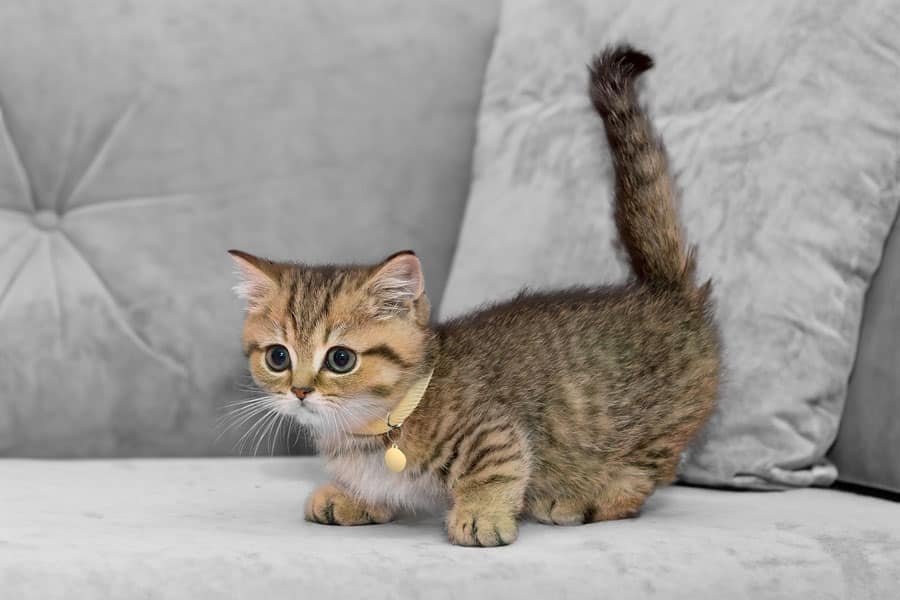
The Munchkin cat is one of the most instantly recognisable and endlessly debated breeds in the modern cat world — a small to medium-sized domestic cat distinguished by its dramatically shortened legs, the result of a naturally occurring genetic mutation that has been selectively cultivated since the 1980s. Named after the small-statured characters from L. Frank Baum’s “The Wizard of Oz,” the Munchkin moves through the world low to the ground with a ferret-like scurry that is simultaneously the most endearing and most controversial characteristic in contemporary cat breeding.
In India’s rapidly growing premium cat market of 2026, the Munchkin has established itself as one of the most searched and most desired cat breeds, driven heavily by social media content featuring these tiny-legged cats sitting upright in a prairie-dog posture or trotting enthusiastically across floors with their characteristic short-legged gait. If you are searching for the Munchkin cat price in India in 2026, this guide gives you accurate current pricing, the honest genetic and health context that every buyer must understand, complete temperament information, and everything needed to make a responsible decision about this unique and polarising breed.
Article Overview — At a Glance
| Attribute | Details |
| Breed Name | Munchkin Cat |
| Origin | USA — naturally occurring mutation; formally developed from 1983 |
| Size | Small-Medium: 2.5–4 kg |
| Lifespan | 12–15 years |
| Leg Types | Standard (normal legs), Super-Short (shortest), and Rug Hugger (extremely short) |
| Coat Types | Shorthair and Longhair varieties |
| Temperament | Playful, curious, sociable, energetic, affectionate, confident |
| Price Range (2026) | Rs. 25,000 – Rs. 1,20,000 |
| TICA Registration | Recognised by TICA since 1994 — not recognised by CFA |
| Monthly Maintenance | Rs. 3,500 – Rs. 8,000 |
| Best For | Apartment dwellers, families, first-time cat owners |
| Health Controversy | Lordosis and Pectus Excavatum are documented concerns |
| Climate Suitability | Good — coat type determines management requirement |
About the Munchkin Cat
The Munchkin’s formal history begins in 1983 when a music teacher named Sandra Hochenedel in Louisiana discovered a pregnant short-legged cat named Blackberry sheltering under a truck. Blackberry’s kittens inherited her shortened legs, and Hochenedel shared one — a male named Toulouse — with a friend named Kay LaFrance. The cats bred freely with the local cat population, and the consistency with which the short-legged trait was passed on suggested a dominant genetic mutation rather than a developmental abnormality.
The mutation responsible for the Munchkin’s shortened legs is the same gene that causes achondroplasia — a form of dwarfism affecting limb bone growth. In the Munchkin, this mutation specifically shortens the long bones of the legs while leaving the spine and body proportions unaffected. This is an important distinction from dog breeds like the Dachshund or Basset Hound, where spinal complications are well-documented — the Munchkin’s spine develops normally because the mutation primarily affects leg bone length.
The International Cat Association (TICA) accepted the Munchkin for championship competition in 2003 after a decade of observation and debate. The Cat Fanciers’ Association (CFA) has not recognised the breed, citing ethical concerns about intentionally breeding cats with a physical mutation that may affect mobility and quality of life. This ongoing controversy — between those who see the Munchkin as a naturally occurring, healthy variation and those who view intentional propagation of a mobility-limiting mutation as ethically questionable — is the central debate that every Indian buyer should be aware of and personally resolve before purchasing.
In India, Munchkin cats began appearing from approximately 2018 onward, with social media content from international Munchkin communities driving extraordinary search interest. By 2024–2025, several Indian breeders in Delhi, Mumbai, and Bangalore have established Munchkin breeding programs, making the breed more accessible than it was just a few years ago.
Munchkin Cat Price in India 2026 — City-Wise Breakdown
| City / Category | Min Price (INR) | Max Price (INR) |
| Delhi / NCR | Rs. 28,000 | Rs. 95,000 |
| Mumbai | Rs. 30,000 | Rs. 1,00,000 |
| Bangalore | Rs. 25,000 | Rs. 88,000 |
| Hyderabad | Rs. 25,000 | Rs. 85,000 |
| Chennai | Rs. 22,000 | Rs. 78,000 |
| Kolkata | Rs. 20,000 | Rs. 75,000 |
| Chandigarh / Jaipur | Rs. 22,000 | Rs. 80,000 |
| Tier-2 / Tier-3 Cities | Rs. 15,000 | Rs. 55,000 |
| TICA Registered / Show Quality | Rs. 70,000 | Rs. 1,20,000+ |
| Imported — USA / Europe | Rs. 90,000 | Rs. 1,50,000+ |
| Longhair Munchkin (popular variant) | Rs. 35,000 | Rs. 1,10,000 |
Note: Munchkin cats at the lower end of India’s price range are often from undocumented breeders without TICA registration for parents. While the cats may still be genuinely Munchkin in appearance, the absence of documented pedigree means health testing history is unknown. Always request TICA registration papers for parent cats and ask specifically about Lordosis and Pectus Excavatum screening. Munchkins in rare colours — lilac, chocolate, or with specific pattern combinations — command the highest premiums.
Leg Types and Varieties
Understanding the Munchkin’s leg length variation is important for buyers. The breed comes in three leg length categories. Standard Munchkins have normal-length legs — these cats carry the Munchkin gene but express it in the heterozygous form, resulting in only moderate shortening. Super-Short Munchkins have the most dramatically shortened legs and are the type most commonly depicted in viral social media content. Rug Huggers are the most extreme expression — legs so short the cat’s belly nearly touches the floor. Rug Huggers are the rarest and most expensive in India’s market.
The Munchkin comes in both shorthair and longhair coat varieties. The longhair Munchkin — with a semi-long, silky coat and a particularly plush appearance — is increasingly popular in India, commanding premiums of approximately 20–30% over shorthair individuals. Both coat varieties occur in the full spectrum of cat colours and patterns.
Temperament and Suitability
The Munchkin’s temperament is one of its most consistently celebrated characteristics — and interestingly, it seems almost entirely unaffected by its physical uniqueness. Munchkin cats do not appear to be aware of or troubled by their shortened legs. They approach life with the complete confidence and enthusiasm of any healthy cat, running, playing, pouncing, and climbing with a characteristic low-slung agility that their owners describe as perpetually entertaining.
They are genuinely playful and remain kitten-like in their enthusiasm for interactive play well into adulthood. They are sociable and affectionate, forming close bonds with their human family while also getting along well with other cats, cat-friendly dogs, and children. Their curiosity is boundless — they investigate every new object, smell, and sound in their environment with persistent, methodical attention. Munchkin owners frequently describe finding their cats sitting upright on their haunches in a prairie-dog posture to peer at something on a higher surface — a characteristic posture that has become one of the breed’s most photographed and beloved behaviours.
They vocalise at a moderate level — not as quiet as Persians, not as vocal as Siamese. Their communication is friendly and responsive rather than demanding. For Indian apartment living, the Munchkin is an outstanding choice — their small size, moderate energy level, sociable indoor temperament, and genuine affection for human company make them ideally suited to the urban Indian household.
Health and Lifespan
The Munchkin’s health profile is the subject of more debate than perhaps any other aspect of the breed, and Indian buyers deserve honest engagement with this debate rather than dismissive reassurance.
Lordosis — excessive inward curvature of the spine — is documented in Munchkin cats at rates higher than in standard-legged cats. Severe lordosis compresses the chest cavity, affecting heart and lung function, and can be fatal in extreme cases. Mild lordosis may have minimal impact on quality of life. Responsible breeders select against lordosis in their breeding programs and can provide information about its prevalence in their bloodlines.
Pectus Excavatum — a chest deformity where the breastbone sinks inward — is also documented in Munchkins. Severe cases compress the heart and lungs, requiring surgical correction. Mild cases may not require intervention but should be monitored.
Osteoarthritis is a long-term concern — the abnormal limb mechanics of shortened legs may create uneven joint stress over years, potentially leading to earlier-onset arthritis than in standard-legged cats. This is an area where long-term population data is still being gathered as the breed is relatively young in formal terms.
The homozygous lethal gene is an important genetic reality: when two Munchkin cats carrying the dominant short-leg gene are bred together, approximately 25% of embryos that inherit two copies of the gene do not survive to birth. This is why responsible Munchkin breeders always breed a Munchkin cat with a standard-legged cat rather than Munchkin-to-Munchkin. Any breeder practising Munchkin-to-Munchkin breeding should raise serious ethical concerns for the buyer.
Despite these documented concerns, many Munchkin cats live healthy, active lives with minimal or no health complications across their 12–15 year lifespan. The key is sourcing from responsible breeders who health-screen their breeding cats and breed Munchkin-to-standard-leg pairings exclusively.
Grooming Guide
Shorthair Munchkins require minimal grooming — weekly brushing with a soft bristle brush or rubber grooming mitt removes loose hair and maintains coat condition. Monthly professional grooming for bathing and nail trimming is recommended.
Longhair Munchkins need more attention — brushing every 2–3 days with a wide-tooth comb prevents mat formation, particularly around the collar area and belly where longer fur rubs against surfaces due to the cat’s low-slung build. Professional grooming every 6–8 weeks is recommended for longhair individuals. In India’s humid climate, thoroughly drying the coat after bathing is important for preventing skin infections under the longer fur.
Monthly Maintenance Cost in India (2026 Estimate)
| Cost Category | Estimated Cost |
| Premium Cat Food (wet + dry) | Rs. 1,500 – Rs. 3,500/month |
| Professional Grooming | Rs. 800 – Rs. 2,000/session; monthly to 6-weekly |
| Litter and Litter Box | Rs. 500 – Rs. 1,200/month |
| Veterinary Care (annual) | Rs. 5,000 – Rs. 14,000 |
| Vaccinations & Preventives | Rs. 2,000 – Rs. 4,500 annually |
| Enrichment and Toys | Rs. 300 – Rs. 700/month |
| Total Estimated Monthly Cost | Rs. 3,500 – Rs. 8,000 |
Frequently Asked Questions (FAQs)
Q1. What is the Munchkin cat price in India in 2026?
Munchkin cat prices from reputable Indian breeders in 2026 range from Rs. 20,000 to Rs. 1,00,000 depending on city, leg length type, coat type, and colour. TICA-registered show-quality Munchkins start at Rs. 70,000. Imported American or European specimens reach Rs. 90,000–Rs. 1,50,000. Longhair Munchkins command a 20–30% premium over shorthair individuals of equivalent quality.
Q2. Do Munchkin cats suffer because of their short legs?
This is the central welfare question surrounding the breed. Most Munchkin cats do not appear to experience pain or distress from their short legs — they run, play, jump (lower than standard cats), and engage in normal feline behaviours with apparent contentment. The documented health concerns are Lordosis and Pectus Excavatum — both of which can range from mild and asymptomatic to serious and requiring intervention. Sourcing from responsible breeders who screen for these conditions and breed Munchkin-to-standard-leg pairings significantly reduces risk.
Q3. Can Munchkin cats climb and jump normally?
Munchkin cats can jump but reach lower heights than standard-legged cats due to their reduced leg leverage. They compensate with remarkable agility — their low centre of gravity actually makes them very stable and manoeuvrable on flat surfaces, and they climb using an alternative technique to standard cats. They navigate stairs, cat trees (lower ones), and furniture with confidence. Providing lower cat trees and furniture ramps makes their environment more accessible and comfortable.
Q4. Is the Munchkin recognised by major cat associations?
TICA (The International Cat Association) recognised the Munchkin for championship competition in 2003. The CFA (Cat Fanciers’ Association) has not recognised the breed, citing welfare concerns about intentionally propagating a mutation that affects mobility. In India, TICA registration is the most reliable documentation for genuine Munchkin breeding quality. The ethical debate about the breed’s intentional propagation is ongoing in the international cat fancy community.
Q5. What is the homozygous lethal gene in Munchkins?
The Munchkin’s short-leg gene is a dominant mutation — one copy produces short legs. Two copies (homozygous) are lethal to the embryo, meaning Munchkin-to-Munchkin breeding results in approximately 25% of embryos not surviving to birth. Responsible Munchkin breeders always pair a Munchkin cat with a standard-legged cat to avoid this outcome. If a breeder claims to breed Munchkin-to-Munchkin, this is a significant ethical red flag indicating either lack of knowledge or disregard for animal welfare.
Conclusion
The Munchkin cat occupies a unique position in India’s 2026 pet market — a breed of undeniable visual charm and genuinely engaging personality that comes with honest health and ethical questions that every buyer must personally resolve. For Indian buyers who source responsibly from breeders who practice Munchkin-to-standard-leg pairings, provide TICA documentation, and actively screen for Lordosis and Pectus Excavatum, the Munchkin offers years of cheerful, affectionate, low-slung companionship. The short legs are not a tragedy — for most well-bred Munchkins they are simply a characteristic, like a Corgi’s short legs or a Dachshund’s long body. The key, as always, is the quality and ethics of the source.