The Birman cat — officially known as the Sacred Cat of Burma — is one of the most legendarily beautiful and historically mystical cat breeds in existence. With its silky semi-long coat in colourpoint patterns, its deep sapphire blue eyes, and most distinctively its pure white “gloves” on each paw — a breed-defining characteristic found in no other cat breed — the Birman carries an appearance of such composed, ethereal elegance that the ancient Burmese legend of its origin feels entirely appropriate. This is a cat that looks, quite genuinely, as though it was touched by something sacred.
In India’s growing premium cat market of 2026, the Birman is an increasingly sought-after breed — appealing to buyers who want the colourpoint Siamese patterning in a semi-longhaired, gentler, quieter, and more serene package. Its combination of stunning appearance, exceptionally gentle temperament, moderate grooming requirements, and apartment-perfect personality makes it one of the finest all-round cat breed choices available in the Indian market. This guide covers accurate 2026 pricing, the legendary history, health facts, and everything needed to make a responsible Birman purchase decision.
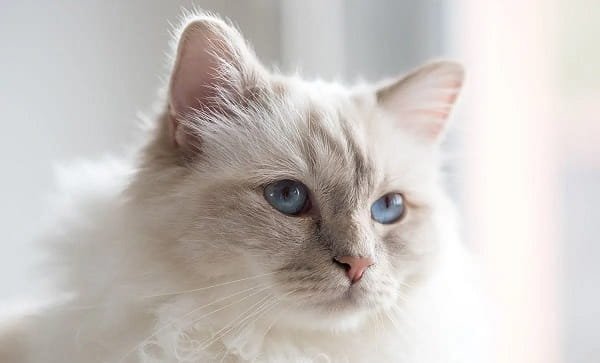
| Attribute | Details |
| Breed Name | Birman (Sacred Cat of Burma / Birmanie) |
| Origin | Burma (Myanmar) — ancient origin; modern breed established in France |
| Size | Medium-Large: 4–7 kg |
| Lifespan | 14–15 years |
| Defining Feature | Pure white gloves on all four paws — found in no other breed |
| Eye Colour | Always deep sapphire blue |
| Coat | Semi-long, silky, single coat — colourpoint pattern; minimal matting |
| Temperament | Gentle, calm, affectionate, social, quiet, adaptable |
| Price Range (2026) | Rs. 30,000 – Rs. 1,20,000 |
| TICA / CFA Show Quality | Rs. 70,000 – Rs. 1,20,000+ |
| Monthly Maintenance | Rs. 3,500 – Rs. 9,000 |
| Best For | Families, apartment dwellers, multi-cat households |
| Climate Suitability | Good — single silky coat less problematic than Persian in Indian humidity |
| Frequently Confused With | Ragdoll (similar appearance but distinct breed) |
About the Birman Cat
The Birman’s legendary origin story is one of the most beautifully constructed in cat breed history. According to Burmese temple legend, a white cat named Sinh was the companion of a holy man, Mun-Ha, who served at the temple of Lao-Tsun — a golden goddess with sapphire blue eyes. When enemies raided the temple and killed Mun-Ha, Sinh placed his paws on his dying master’s body and faced the goddess. The cat’s white coat turned to gold, his eyes transformed to sapphire blue, and his paws — where they touched the holy man’s white hair — remained pure white as a symbol of the purity of his master’s soul. When Sinh died seven days later, he carried the souls of the priests with him to paradise.
The historical reality of the Birman’s origin is more complex and partially unknown. The breed was brought to France in the 1920s — reportedly gifted to a French couple by Burmese temple priests in gratitude for their assistance defending the temple. The early French breeding program was nearly destroyed during World War II when the breeding population was decimated. Post-war revival required extensive outcrossing with Persian, Himalayan, and other longhaired cats to rebuild the population, with strict selection for the pure white gloves that define the breed.
The white gloves are the Birman’s most breed-specific characteristic — pure white, extending precisely to the transition of the paw. The symmetry and purity of the gloves are critical in show evaluation and are genetically distinct from the white spotting gene that creates white markings in other breeds. The Birman’s white gloves are caused by a specific gene that restricts white to the extremities in a precise pattern unique to the breed.
In India, Birman cats have been growing in visibility and availability through 2022–2025, with breeders in Mumbai and Bangalore beginning to produce TICA-registered litters. The breed appeals particularly to buyers who want the Ragdoll’s appearance and gentle temperament but find the Ragdoll’s extremely relaxed, floppy personality slightly too passive — the Birman retains more active curiosity and playfulness within its gentle frame.
Birman Cat Price in India 2026 — City-Wise Breakdown
| City / Category | Min Price (INR) | Max Price (INR) |
| Delhi / NCR | Rs. 35,000 | Rs. 1,00,000 |
| Mumbai | Rs. 38,000 | Rs. 1,10,000 |
| Bangalore | Rs. 32,000 | Rs. 95,000 |
| Hyderabad | Rs. 28,000 | Rs. 88,000 |
| Chennai / Kolkata | Rs. 25,000 | Rs. 82,000 |
| Tier-2 / Tier-3 Cities | Rs. 18,000 | Rs. 58,000 |
| TICA / CFA Registered Show Quality | Rs. 70,000 | Rs. 1,20,000+ |
| Imported — France / Europe / USA | Rs. 90,000 | Rs. 1,50,000+ |
Colour Varieties
The Birman comes in all the standard pointed colours — Seal Point (dark brown-black points), Blue Point (grey points), Chocolate Point, Lilac Point, and various tortie and tabby point combinations. All varieties have the defining deep sapphire blue eyes and pure white gloves. Seal Point is the most classic and widely available in India. Chocolate and Lilac Points are rarest and command premiums of 20–35%.
Temperament and Suitability
The Birman occupies what many cat enthusiasts describe as the perfect temperament middle ground — more active and curious than the extremely passive Ragdoll, quieter and less demanding than the intensely vocal Siamese, more social and affectionate than the independent British Shorthair. This balanced personality profile makes the Birman one of the most broadly suitable cat breeds for diverse Indian household types.
They are genuinely gentle — the Birman is one of the least aggressive domestic cat breeds, rarely using claws or teeth in response to handling. This gentleness with children is exceptional — Birmans tolerate enthusiastic handling with patient composure that most breeds would resist. They get along well with other cats and cat-friendly dogs, making multi-pet households manageable.
Their sociability means they prefer human company but manage working-hour solitude better than extremely social breeds like the Siamese or Ragdoll. A companion cat significantly improves their welfare during extended alone time. They are moderately vocal — communicating with soft, gentle chirps rather than demanding vocalisation. For Indian apartments, the Birman’s quiet sociability, moderate size, and adaptable temperament make it an outstanding choice.
Health and Lifespan
The Birman is generally a healthy breed with a 14–15 year lifespan. The primary hereditary health concern is Hypertrophic Cardiomyopathy (HCM) — annual echocardiographic screening of breeding cats is the responsible standard. A DNA test for one HCM mutation exists for Birmans. Hypokalaemia (low blood potassium causing muscle weakness) is documented in the breed — DNA test available. Congenital Hypotrichosis (hereditary hairlessness) occurs very rarely in some bloodlines.
The single silky coat — unlike the Persian’s dense double coat — handles India’s humidity significantly better, with lower matting risk and easier maintenance. Weekly brushing prevents any tangling and professional grooming every 6–8 weeks maintains coat quality. In India’s summer, the single coat provides reasonable heat management without the intensive climate infrastructure Arctic breeds require.
Monthly Maintenance Cost in India (2026 Estimate)
| Cost Category | Estimated Cost |
| Premium Cat Food | Rs. 1,800 – Rs. 4,000/month |
| Professional Grooming (single silky coat) | Rs. 900 – Rs. 2,200/session; every 6–8 weeks |
| Litter and Litter Box | Rs. 500 – Rs. 1,200/month |
| Veterinary Care (annual incl. HCM) | Rs. 6,000 – Rs. 15,000 |
| Vaccinations & Preventives | Rs. 2,000 – Rs. 4,500 annually |
| Total Estimated Monthly Cost | Rs. 3,500 – Rs. 9,000 |
Frequently Asked Questions (FAQs)
Q1. What is the Birman cat price in India in 2026?
A: Birman cat prices from reputable breeders in India in 2026 range from Rs. 25,000 to Rs. 1,10,000. TICA or CFA-registered show-quality Birmans from HCM-screened parents start at Rs. 70,000 in metro cities. European imports reach Rs. 90,000–Rs. 1,50,000+ including import costs. Chocolate and Lilac Point varieties command 20–35% premiums over Seal and Blue.
Q2. What are the Birman’s white gloves and why are they unique?
A: The Birman’s pure white paws — called gloves — are a breed-defining genetic characteristic found in no other cat breed. Caused by a specific gene that restricts white precisely to the paw extremities, the gloves must be pure white and symmetrical in show-quality Birmans. The hind gloves extend further up the back of the leg in a shape called “laces.” The legend of their origin — Sinh’s paws remaining white where they touched the holy man’s white hair — is one of the most beautiful stories in cat breed history.
Q3. How is the Birman different from the Ragdoll?
A: Both are semi-longhaired, blue-eyed, colourpoint cats of similar size and gentle temperament. Key differences: the Birman has the unique white gloves that the Ragdoll lacks. The Ragdoll is larger. The Ragdoll is more passive and floppy when handled; the Birman retains more active curiosity and playfulness. The Birman’s coat is silkier and less prone to matting than the Ragdoll’s denser semi-long coat. Both are excellent apartment cats.
Q4. Is the Birman a good family cat with children in India?
A: The Birman is one of the best cat breeds for families with children. Its exceptional gentleness — rarely using claws or teeth even when handled roughly — combined with its patient, social temperament makes it extraordinarily reliable with children. Multiple Indian breeders and owners confirm the Birman’s consistent, gentle behaviour even with enthusiastic young children makes it one of their primary recommendations for Indian families seeking a first pedigreed cat.
Q5. Does the Birman coat mat easily in India’s humid climate?
A: The Birman’s single, silky coat has significantly lower matting tendency than the Persian’s dense double coat — a genuine practical advantage in India’s humidity. Weekly brushing with a wide-tooth comb prevents any tangles from developing. Professional grooming every 6–8 weeks for bathing and light trimming keeps the coat in excellent condition. The Birman’s coat is one of the most manageable among semi-longhaired cat breeds in Indian climatic conditions.