The Indian kitchen is one of the most intensively used rooms in any home in the world. Three to four meals prepared daily. Spices numbered in dozens. Cooking vessels accumulated across generations. Ingredients in quantities that reflect the hospitality impulse of Indian cooking culture. And typically, a physical footprint that is modest relative to the operational demands placed on it.
Organising an Indian kitchen isn’t about applying Scandinavian minimalism to a context where it fundamentally doesn’t fit. It’s about creating intelligent systems — for storage, access, and workflow — that honour the abundance of Indian cooking while making every session more efficient and less frustrating.
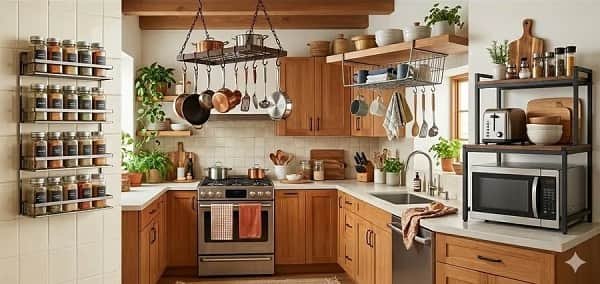
The Decant System for Spices and Dal
The most transformative single kitchen organisation intervention for Indian families is decanting. Spices and pulses that arrive in varying bag sizes, torn packets, and mismatched containers create visual chaos and practical inefficiency — identical glass or plastic jars in a consistent size, labelled clearly, create instant order.
Invest in twenty to thirty uniform airtight containers — available affordably in Indian markets and online. Decant all spices, dal varieties, and dry staples into these containers and label them. The visual consistency immediately organises the kitchen psychologically, and the airtight storage extends shelf life. Arrange spice containers in a tiered spice rack drawer or rotating carousel for full visibility without the stacking archaeology that mixed-container storage creates.
Zones Based on Indian Cooking Workflow
An organised Indian kitchen is structured around the actual workflow of Indian cooking — not the theoretical workflow of a generic kitchen. Define three primary zones.
The masala and prep zone — immediately accessible from the cooking surface — holds daily-use spices, chopping boards, and prep utensils. The cooking zone around the hob holds oil, salt, and the three to five ingredients used in every cooking session within arm’s reach. The storage zone away from the cooking surface holds pulses, grains, and less-frequently used ingredients.
This workflow zoning eliminates the cross-kitchen reaching and searching that adds friction to every cooking session.
Vertical Cabinet Organisation
Standard Indian kitchen cabinets are deep — and depth creates the inaccessibility problem where items at the back are effectively lost until a thorough cabinet excavation is conducted. Pull-out cabinet organisers — tiered shelving that slides forward to reveal the full cabinet depth — solve this problem at a modest cost.
Alternatively, using only the front two-thirds of deep cabinets for active storage and reserving the back third for rarely used items with a clear inventory creates a functional approximation of the pull-out solution without the hardware investment.
Plate racks mounted vertically in cabinets store plates on their edges rather than stacking — making individual plate access without disturbing the stack possible, which matters when the full stack has accumulated to twenty plates.
Under-Sink Maximisation
The space under the kitchen sink is almost universally underused in Indian kitchens — occupied by cleaning supplies in a disorganised heap. A two-tier pull-out drawer unit, a tension rod system for hanging spray bottles, and door-mounted organisers for smaller cleaning items collectively transform this space into a comprehensively organised cleaning zone.
Counter Space Discipline
Counter space is the most valuable resource in a small Indian kitchen — and its value is only realised when it’s kept clear. Every appliance that lives permanently on the counter should justify its counter occupancy by daily use. The mixer-grinder earns its counter space because it’s used three times daily. The idli stand that appears once a week should live in a cabinet.
A counter that is predominantly clear between active cooking sessions makes food preparation faster, easier, and more pleasant — the workspace is ready immediately rather than requiring clearing before cooking can begin.
Refrigerator Organisation With Indian Food Categories
Indian families use the refrigerator differently from many other global cooking cultures — marinated meats, pre-soaked legumes, fresh curry leaves, coconut, and cooked curry for the day all occupy space simultaneously. Organising the refrigerator by category — a designated shelf for cooked food, a drawer for fresh produce, a door section for condiments and pickles, a dedicated container for pre-soaked legumes — eliminates the daily rearrangement that an unorganised refrigerator requires and reduces food waste from forgotten items.
Clear containers for stored cooked food — rather than opaque steel dabbas — make contents immediately visible and reduce the discovery of forgotten curry three weeks later.
Frequently Asked Questions (FAQs)
Q1. How long does a complete Indian kitchen organisation project typically take?
A full decant, sort, and reorganise of an average Indian family kitchen — including installing new storage solutions — takes a committed weekend of approximately twelve to sixteen hours. Breaking it into smaller sessions — one cabinet per evening over two weeks — makes the project manageable without requiring a complete kitchen shutdown. The critical insight is that the first two to three hours of sorting and discarding expired or unused items typically clears enough space to make the subsequent organisation significantly easier than anticipated.
Q2. What kitchen organisation products are available affordably in India?
The Indian market has excellent options across all price points — stainless steel spice racks and container sets from local kitchen stores, airtight container sets from brands like Signoraware and Milton, cabinet pull-out organisers from hardware stores, and over-door organiser racks from online marketplaces. A comprehensive kitchen organisation product purchase — containers, racks, and drawer organisers — can be accomplished for ₹2,000 to ₹6,000 for a medium-size Indian kitchen.
Q3. How do I maintain kitchen organisation with a busy family schedule?
Organisation systems succeed only when every family member who uses the kitchen understands the system — where things go and why. A ten-minute weekly reset — everything back in its designated place — maintains the organisation without requiring daily discipline. The most sustainable systems are the simplest ones — fewer categories, obvious placement logic, and containers that are easy to open and replace one-handed while cooking.
Q4. Should I use open shelving or closed cabinets in an Indian kitchen?
Open shelving creates visual appeal but requires consistent organisation discipline — every item is always on display. In busy Indian family kitchens where the cooking volume creates inevitable visual variation throughout the day, closed cabinets with organised interiors are more practical than open shelving that requires perpetual maintenance to look designed. A hybrid approach — open shelving for the most beautiful items — organised spice jars, attractive vessels — and closed storage for everything else — captures the aesthetic benefit while containing the maintenance requirement.
Q5. What is the most impactful single kitchen organisation change for an Indian family with limited time and budget?
The spice decant into uniform airtight containers is the highest single-impact organisation intervention available to an Indian kitchen — it addresses the visual, functional, and storage quality dimensions simultaneously, transforms the look of the kitchen’s most-used area, and costs ₹500 to ₹1,500 for the containers. The impact of this single change consistently surprises families who implement it — the kitchen looks and functions fundamentally better from this one action alone.